USAID DEC
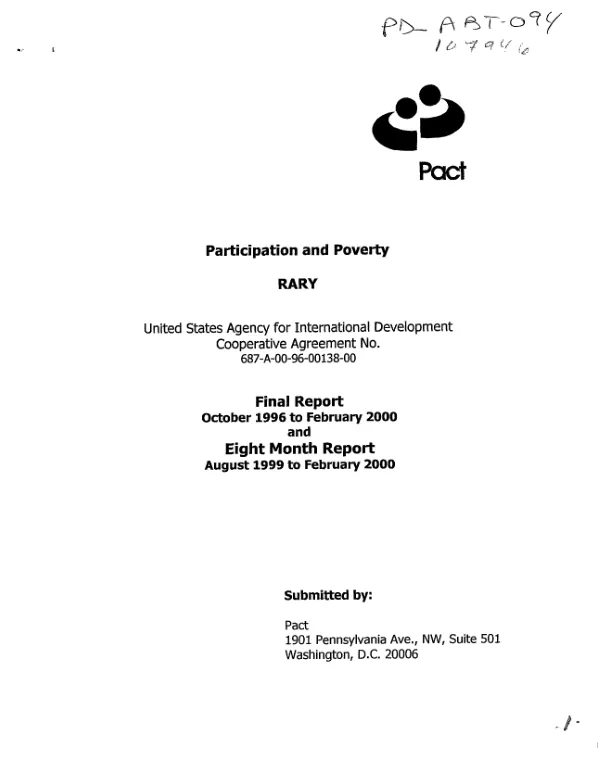
Participation and poverty project (RARY) : final report, October 1, 1996 to February 2000 and eight month report August 1999 to February 2000
Sign inPACT, INC.
Participation and poverty project (RARY) : final report, October 1, 1996 to February 2000 and eight month report August 1999 to February 2000
Final report of Private Agencies Collaborating Together (PACT) on a contract (10/96-2/00) to foster civil society (CS) in Madagascar, with emphasis on increasing citizen participation in policymaking aimed at alleviating poverty (RARY project).
1970
Sign in to readA free account is required to download.
Abstract
The value and opportunity of CS participation in governance, as perceived by government officials in both Fianarantsoa and Mahajanga, has evolved dramatically as a result of the project. In both cities, officials have gone from a rather negative stance to establishing durable mechanisms to include CS organizations in public decisionmaking. In Mahajanga, the mayor reserved two seats on the City"s steering committee to CS representatives and collaborated fully with neighborhood associations federated under the CS organization Hery Miray in negotiating the City"s water privatization program. The City provided Hery Miray with access to all relevant information and to city technicians. The federation had significant impact on City policy regarding water management. CS organizations are now part of the City"s protocol lists and are present at all significant events. Hery Miray is regularly consulted prior to decisions regarding neighborhoods. In Fianarantsoa, City officials regularly consult with merchant and neighborhood associations and with transport operators on matters of concern to these groups. The city has a policy of public information and systematic consultation on all major issues. In both Mahajanga and Fianarantsoa, the CS environment has changed notably. Whereas in 1997 there was no recorded participation of CS organizations in the public arena, now several durable organizations are involved in key issues that affect citizen welfare. In Mahajanga, neighborhood associations, mostly self-help groups, are federated within a 48-member organization that has sufficient weight to tip the balance in municipal elections. This organization is involved in applying a new national policy on water privatization and cost recovery; it is also providing training and support to increase member organization capacity to manage individual water fountains. Mahajanga journalists are now represented by a 25-member association, AJM, which is playing a major role in key issues such as water management and land tenure. In Fianarantsoa, several new organizations play an active role on a local and regional level. Federations of youth organizations and of transport operators, an advocacy group on provincial autonomy, and a journalist association now exist. Already extant organizations such as UAPH (Disabled Persons) and FMMF (Independent Doctors) became more active in the public arena as result of project activities. Moreover, neighborhood associations have prioritized health and sanitation issues and have mobilized to resolve hem. All organizations have greater organizational and technical capacity than at project outset. All except the journalist associations have developed a position vis-a-vis the community and, in three cases, vis-a-vis specific government policy. Also in three cases, organizations united to form a federation. All organizations initiated forums on issues, and two engaged in head-on advocacy campaigns on specific issues. All but one organization developed a significant relationship with decisionmakers. The combined impact of activities under the first and second project results have contributed to expected result three. More openness of decisionmakers, combined with an expansion of CS, have generated an environment more conducive to citizen participation. Both cities saw a notable increase in dialogue and debate on issues. CS organizations are more often referred to and called upon by decisionmakers. Two organizations, Miaramivoy and MMDF, have actively campaigned with civic messages, respectively on provincial autonomy and passenger rights. Further indicators of impact under expected result three are the adoption by both cities of a more transparent budget nomenclature; improvements in council-executive relations; creation of a non-partisan communication service; and adoption in Fianarantsoa of a policy on communication, participation, and access to information. Moreover, journalist capacity has improved, and a new journalist association exists in each city. Numerous lessons learned are detailed.
Related documents
Documents in this collection
 1970
1970USAID DEC
Participation and poverty project (RARY) : annual report, January 1, 1997-September 30, 1997 and annual work plan, October 1, 1997-September 30, 1998
Open record 2006
2006USAID DEC
![NDI [National Democratic Institute] Namibia : final report -- CO-AG [cooperative agreement] no. 690-A-00-98-00228-00 : consolidation [of] parliamentary democracy in Namibia](https://covers.devme.ai/gen/74434.webp)
![Final report : civil society proposing policy alternatives [CSPPA] : cooperative agreement no. 656-A-00-98-00049-00](https://covers.devme.ai/gen/13994.webp)
![Final report : increased citizen participation project : grant award no. 654-G-00-98-0059-00 [i.e. 654-G-00-98-00059-00]](https://covers.devme.ai/gen/105888.webp)