USAID. BUR. FOR EUROPE AND NEAR EAST
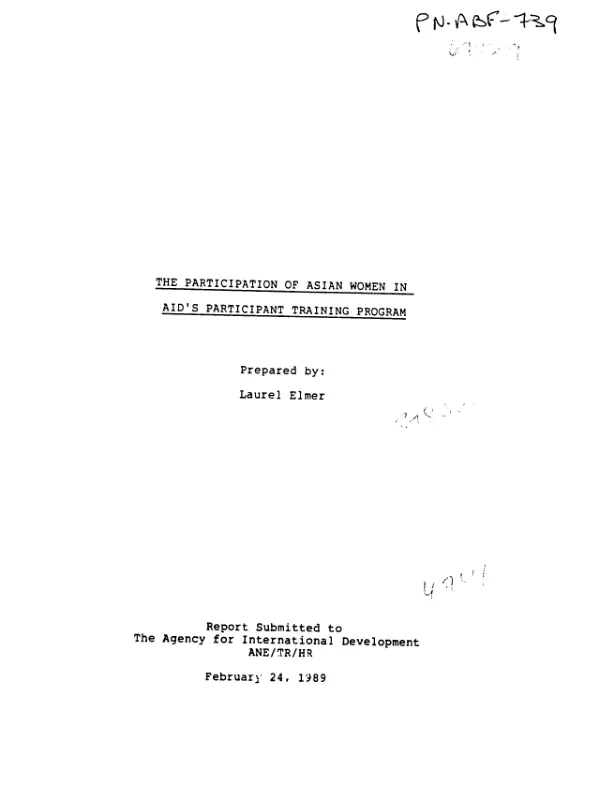
Participation of women in A.I.D."s training programs for Asia and the Near East
Women make up a low percentage of A.I.D.
Cotter, Jim; Held, Ann · 1990
Sign in to readA free account is required to download.
Abstract
participants from the Asia and Near East region in U.S. and third-country training programs, accounting for only 14.8% (Asia) and 17.6% (Near East) in 1989. This report, based on two subregional reports on the subject (PN-ABF-738/739), identifies the primary reasons for this imbalance. (1) Very few women are employed in A.I.D."s traditional focus groups (i.e., mid-level public sector technicians, managers, and policymakers). (2) Few women earn university degrees in the scientific and technical areas, since these fields fall outside the cultural norm for women. (3) Dissemination of participant training information has often been limited to male-dominated host government channels. (4) Few women meet English language requirements. (5) Cultural and social mores, especially in Islamic areas, prohibit mixed-gender travel, living and, in some cases, study facilities. Domestic responsibilities do not pose a significant hindrance, since most women eligible for overseas training are from higher income families and can afford household help. The report also examines constraints to women"s participation in local training. In this case, household responsibilities are considered a major impediment, since rural women tend to have large families and demanding agricultural workloads. Moreover, activities not related to the home environment are considered inappropriate and morally questionable. The report also cites taboos on women"s interaction with non-related males, including male instructors, as constraints to women"s participation. Recommendations address these constraints; a set of guidelines is provided in a follow-on document (PN-ABG-704). Appendices include case studies of Bangladesh, Egypt, India, Indonesia, Jordan, Morocco, Nepal, Pakistan, and Yemen.
Related documents