CARE NEPAL
Participatory Well-Being Ranking: A Tool for Poverty Reduction in Nepal
The Participatory Well-Being Ranking is a process used to identify poor households and individuals in communities, enabling poverty reduction support through community forestry initiatives.
2013 · 2 pages
Sign in to readA free account is required to download.
Abstract
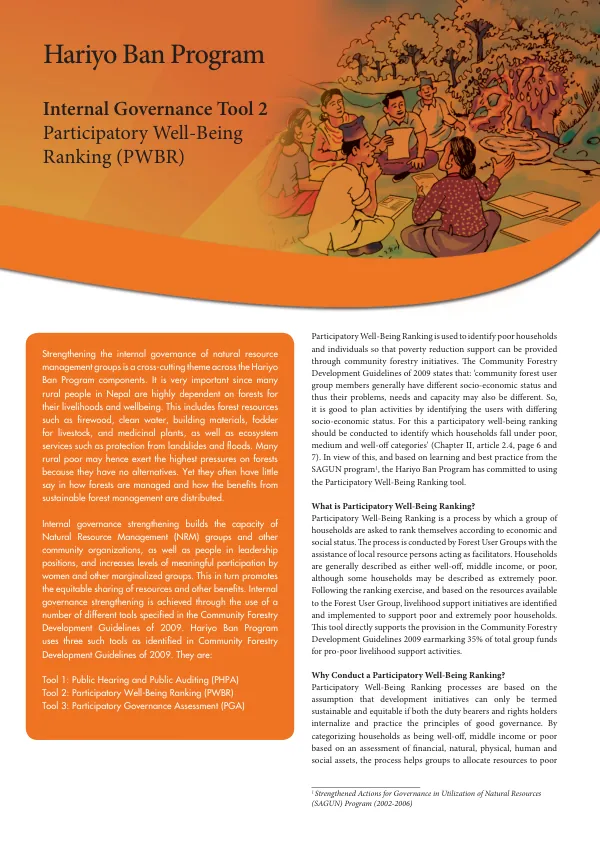
This process is based on the Community Forestry Development Guidelines of 2009, which emphasize the importance of planning activities by identifying community members with differing socio-economic status. The Hariyo Ban Program has committed to using the Participatory Well-Being Ranking tool, drawing on learning and best practices from the SAGUN program. The Participatory Well-Being Ranking process involves categorizing households as well-off, middle income, or poor based on an assessment of financial, natural, physical, human, and social assets. This process is conducted by Forest User Groups with the assistance of local resource persons acting as facilitators. Households are generally described as either well-off, middle income, or poor, although some households may be described as extremely poor. Following the ranking exercise, livelihood support initiatives are identified and implemented to support poor and extremely poor households. The Participatory Well-Being Ranking process has three main phases. The preparatory phase involves delivering an orientation session on the process and associated objectives to the User Group's executive committee and members. The facilitators then prepare a list of the names of the heads of all member households, and the date, time, and venue for the ranking exercise are announced. Other local stakeholders are also invited. During the participatory well-being ranking phase, facilitators lead the discussion, ensuring that as much interaction as possible takes place. At least 75% of all member households should participate in the process. Participants choose the criteria they will use to categorize households, which may include land holdings and other property, availability of food grains, education level of family members, family size, income from employment and remittance, social status within the community, and vulnerability to climate hazards. Each household is ranked according to each of the criteria, and on the basis of this information, households are categorized as well-off, middle income, or poor. Extremely poor households are also identified so that special livelihood support initiatives can be designed based on their needs and interests. The results of the Participatory Well-Being Ranking exercises can be used by Forest User Groups in the preparation and updating of Forest Operational Plans and User Group constitutions. Regular follow-up for action plans developed during the process and for livelihood improvement plans is essential. Information collected during ranking exercises also provides a baseline for the Hariyo Ban Program to assess changes in the livelihoods of poor forest users over a period of time. The Hariyo Ban Program is a USAID-funded initiative that aims to reduce the adverse impacts of climate change and threats to biodiversity in Nepal by working with the government, communities, civil society, and private sector.
Related documents