CARE NEPAL
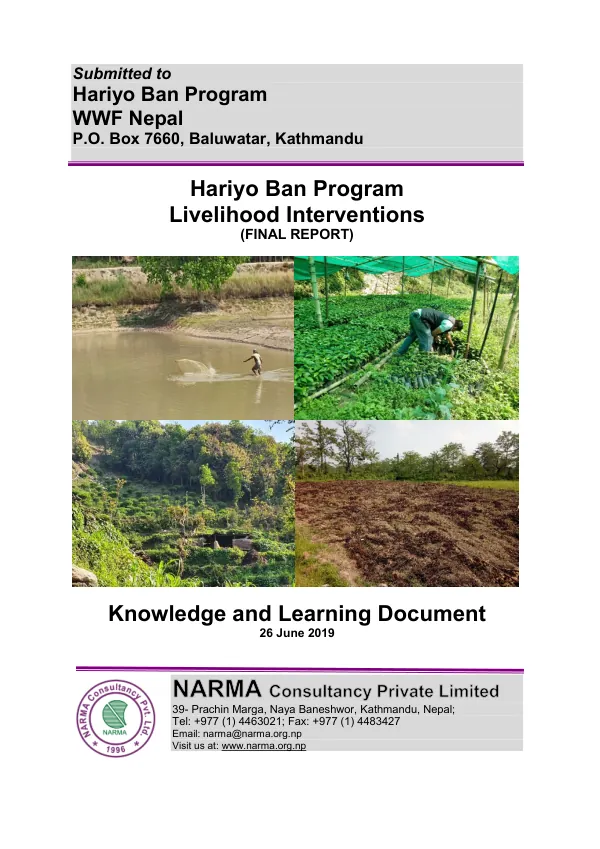
Knowledge and Learning Document: Livelihood Interventions in Hariyo Ban
The Hariyo Ban Program is a five-year initiative implemented in the Chitwan Annapurna Landscape (CHAL) and Tarai Arc Landscape (TAL) with the objectives of improving conservation and management of these landscapes while reducing climate change vulnerability.
2019 · 95 pages
Sign in to readA free account is required to download.
Abstract
The program focuses on developing market-based livelihood alternatives to raise the economic status of beneficiaries and reduce their dependency on forest resources. The study aimed to document knowledge and learnings from the livelihood interventions supported by the Hariyo Ban Program. A participatory and reiterative methodology was adopted, focusing on the processes initiated to determine and implement interventions, inputs, intended outcomes, and outcomes achieved. Semi-structured questionnaires were administered through Focused Group Discussions (FGDs) and semi-structured interviews with key stakeholders. The study framework guided the steps of the methodology, which included seven areas of inquiry: appropriateness of interventions, inclusiveness and equity, effectiveness of market-based model versus equity-based model, market linkages and involvement of the private sector, collaboration, linkages, and partnerships, outcomes/effects of intervention, and sustainability of interventions. A total of 59 enterprises were studied, including 16 regular program enterprises and 2 Small Grants Program (SGP) enterprises. The enterprises were categorized as small, medium, and large, with 7, 5, and 2 enterprises, respectively. The SGP enterprises were implemented by WWF, engaging SGP Bee Keeping Industry and Organic Valley Private Ltd. The enterprises were situated in Banke and Kanchanpur Districts of TAL and Kaski, Chitwan, Nawalparasi, and other districts of TAL. The interventions were implemented through NRM-based organizations, such as CFUGs and BZUGs, located adjacent to hotspots like Pancheshwor Protected Forest, Chitwan National Park, and Shuklaphanta National Park. The majority of beneficiaries and stakeholders of the enterprises were from poor and forest-dependent households, with most being women, including women from dalit, ex-Halamiya, and ethnic groups. Hariyo Ban support to these enterprises included financial assistance through grants and the establishment of a revolving fund, technical support for skills development and operation and management capacity building, and material inputs such as seedlings, manure, and equipment. Key findings from the study indicate that the implementation of the enterprises has led to a decrease in the dependency of people on forest resources. This is attributed to the development of alternative livelihood opportunities, improved transportation systems, increased availability of LPG and biogas, and the planting of fodder and grasses in and around own farms and leased land. The study revealed that providing alternative livelihood opportunities has reduced the need for people to depend on forest resources. The enterprises have also improved the economic status of beneficiaries, with increased income and reduced poverty. The study highlights the importance of market-based livelihood alternatives in reducing climate change vulnerability and improving the livelihoods of forest-dependent communities. The Hariyo Ban Program has supported the development of market-based livelihood alternatives, which has contributed to the reduction of climate change vulnerability in the CHAL and TAL landscapes. The program has also improved the livelihoods of forest-dependent communities, with increased income and reduced poverty. The study recommends that the program continue to support the development of market-based livelihood alternatives and provide technical and financial support to beneficiaries to improve the sustainability of interventions. The study concludes that the Hariyo Ban Program has made significant contributions to the conservation and management of the CHAL and TAL landscapes while reducing climate change vulnerability. The program has also improved the livelihoods of forest-dependent communities, with increased income and reduced poverty. The study highlights the importance of market-based livelihood alternatives in reducing climate change vulnerability and improving the livelihoods of forest-dependent communities.