DAI
Partnership Paper: SERVIR Program Demand Activity
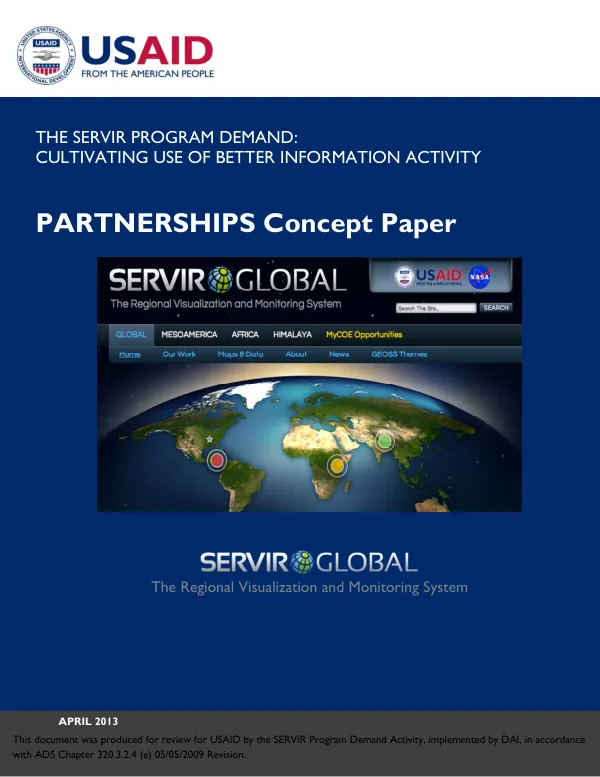
The SERVIR Program Demand: Cultivating Use of Better Information Activity is a concept paper produced for review by USAID in April 2013.
2013 · 6 pages
Sign in to readA free account is required to download.
Abstract
The document outlines the SERVIR Program's growth and increasing demand for its products and services. As the program expands, it has become essential to establish strategic partnerships to leverage the strengths and experiences of each partner. The SERVIR stakeholder network is complex, with partnerships between USAID and NASA, regional hubs, and other agencies and programs. The program's partnerships are categorized into seven types: interagency, between donors, between hubs, with hubs and spokes, between hubs and other institutions, between hubs and USAID regional and bilateral missions, and with the private sector. Interagency partnerships involve collaborations between U.S. government agencies, such as the Environmental Protection Agency (EPA) and the U.S. Forest Service. These partnerships can bring financial and programmatic benefits and synergies. Between donors, partnerships involve collaborations with multi- and bilateral donors, such as the Japan International Cooperation Agency (JICA) and the World Bank. Between hubs, partnerships involve collaborations between regional hubs, such as CATHALAC and RCMRD. These partnerships can facilitate joint development of SERVIR applications, shared problem-solving, and knowledge sharing. SERVIR hubs and spokes involve partnerships between regional hubs and country-level partners, which can provide a means for countries and institutions to partner with SERVIR. Between hubs and other institutions, partnerships involve collaborations with research institutions and NGOs operating in related sectors. These partnerships can bring additional value to SERVIR. Between hubs and USAID regional and bilateral missions, partnerships involve collaborations between hub institutions and USAID missions, which can facilitate the long-term sustainability of SERVIR and the hub institutions. Private sector partnerships involve collaborations with private sector companies in the aerospace and geospatial industries. These partnerships can bring new technologies into SERVIR and enhance outreach. However, it is essential to fully analyze these partnerships to ensure they provide a clear net benefit to SERVIR. The SERVIR Program's partnerships are essential for its growth and effectiveness. By establishing strategic partnerships, the program can leverage the strengths and experiences of each partner and provide better information to support environmental decision-making.
Related documents