USAID DEC
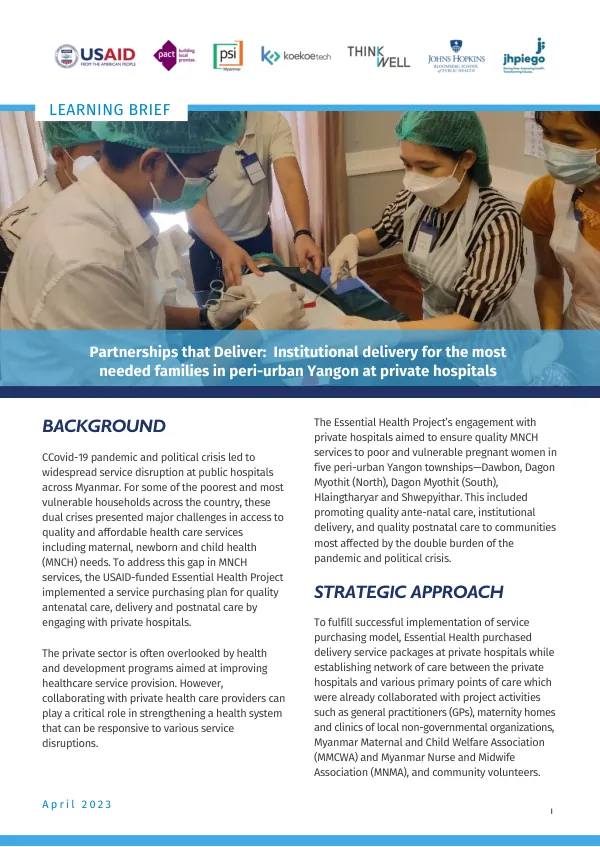
Partnerships that Deliver: Institutional delivery for the most needed families in peri-urban Yangon at private hospitals
Sign inUSAID
Partnerships that Deliver: Institutional delivery for the most needed families in peri-urban Yangon at private hospitals
The Essential Health project implemented a service purchasing model for quality antenatal care, delivery, and postnatal care by engaging with private hospitals in peri-urban Yangon townships.
2023 · 6 pages
Sign in to readA free account is required to download.
Abstract
The project aimed to address the gap in maternal, newborn, and child health (MNCH) services caused by the COVID-19 pandemic and political crisis. The private sector was engaged to strengthen the health system's responsiveness to service disruptions. The project's approach involved mapping out services and needs of the townships, introducing a service purchasing plan to private hospitals, and establishing a network of care between private hospitals, general practitioners, maternity homes, clinics, and community volunteers. The network included the Myanmar Maternal and Child Welfare Association (MMCWA) and the Myanmar Nurse and Midwife Association (MNMA). The project's implementation steps included exploration of available private hospitals, expression of interest, regular follow-up and communication, selection of private hospitals, capacity building, quality improvement, and remote mentorship. The selection process involved reviewing background information, delivery costs, and costs for normal, instrumental, and Cesarean deliveries. The project maintained regular coordination with private hospitals to address urgent needs or issues. The project maintained regular coordination with private hospitals to address urgent needs or issues. Private hospitals prepared documentation to begin the reimbursement process, which was verified by the project. The process was further checked with random phone calls to 40% of clients and by reviewing clients' satisfaction with services received and any additional costs. The project helped strengthen capacity in using the national surgical safety checklist endorsed by the Ministry of Health, which was adapted based on the WHO surgical safety checklist. The project provided regular quality improvement support and training to private hospitals in accordance with the technical service contract. The project conducted focus group discussions and networking meetings with private hospitals and primary points of care in MNCH. The purpose of the focus groups was to explore opportunities to continue supporting delivery care in private hospitals, particularly for poor and vulnerable households. Valuable recommendations for future activities emerged during the discussion, including the need to further strengthen links between private hospitals with maternity homes and clinics and general practitioners. The project supported 956 pregnant women for antenatal care, 824 pregnant women for institutional delivery and postnatal care, and 851 pregnant women for basic laboratory investigations. The project also provided six capacity-building sessions to 24 healthcare providers. The project's engagement with private hospitals improved the quality of care at private hospitals. The project's approach to strengthening capacity in using the national surgical safety checklist and providing regular quality improvement support and training to private hospitals contributed to the improvement in quality of care. The project's focus on strengthening links between private hospitals with maternity homes and clinics and general practitioners also contributed to the improvement in quality of care.