SAVE THE CHILDREN FUND
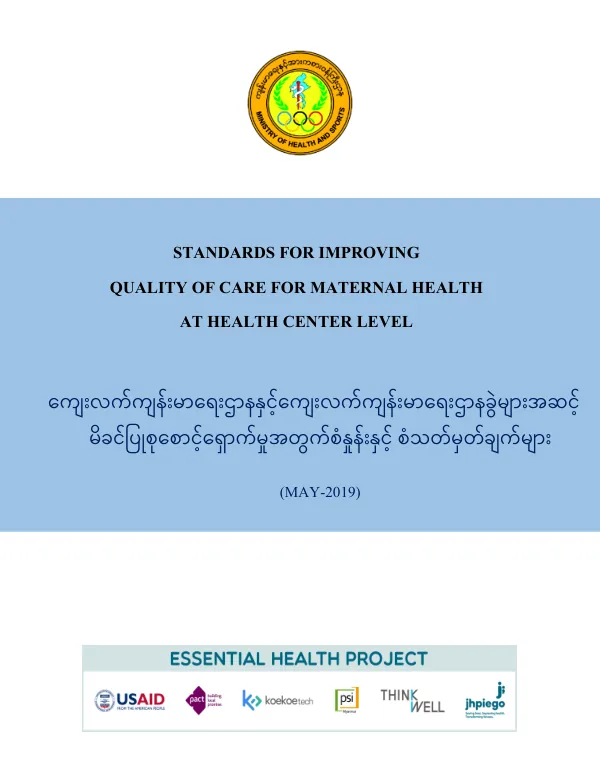
STANDARDS FOR IMPROVING QUALITY OF CARE FOR MATERNAL HEALTH AT HOSPITAL LEVEL
The Standards for Improving Quality of Care for Maternal Health at Hospital Level were developed by the Maternal and Reproductive Health Division of the Ministry of Health and Sports, Myanmar, with contributions from various organizations and technical assistance from the U.S.
88 pages
Sign in to readA free account is required to download.
Abstract
Agency for International Development (USAID)-funded Essential Health Project. The standards aim to improve the quality of care for maternal health at hospital level, focusing on eight key areas. The first standard emphasizes the provision of routine, evidence-based care and management of complications during antenatal, labor, childbirth, and the early postnatal period, according to national guidelines. To achieve this standard, hospitals must have written up-to-date national antenatal care guidelines, essential equipment and supplies, and essential drugs and vaccines. Health-care staff must receive in-service training and regular refresher sessions at least once every 12 months in routine antenatal care and identification and management of emergency complications. The second standard focuses on the health information system, enabling the use of data to ensure early and appropriate action to improve the care of every woman. This includes the collection and analysis of data on maternal and newborn health outcomes, as well as the use of data to inform decision-making and improve the quality of care. The third standard emphasizes the provision of timely and appropriate referral for women with conditions that cannot be managed effectively with available resources. This includes the identification of women who require referral to higher-level facilities and the provision of transportation and other necessary support. The fourth standard highlights the importance of effective communication with women and their families, responding to their needs and preferences. This includes the provision of clear and accurate information, respect for women's autonomy and dignity, and the use of interpreters or other communication aids as needed. The fifth standard emphasizes the provision of care with respect and preservation of women's dignity, including the use of respectful language and behavior, and the provision of privacy and confidentiality. The sixth standard focuses on the provision of emotional support to women and their families, including counseling and other forms of support to help women cope with the challenges of pregnancy and childbirth. The seventh standard emphasizes the importance of having competent and motivated staff available to provide routine care and manage complications. This includes the provision of ongoing training and support for health-care staff, as well as the use of performance-based incentives to motivate staff. The eighth standard highlights the importance of having an appropriate physical environment, with adequate water, sanitation, and energy supplies, medicines, supplies, and equipment for routine maternal care and management of complications. To achieve these standards, hospitals must have essential laboratory supplies and tests, including hemoglobin level, urine RE, urine protein, and sugar, asymptomatic bacteriuria, syphilis, HIV, ABO blood grouping and Rh, blood sugar, and HbsAg. They must also have counseling units for PMTCT of HIV test for pregnant women. In terms of process, hospitals must assess the body weight, blood pressure, pulse, and temperature of pregnant women, as well as their gestational age and fetal heart rate. They must also perform tests on hemoglobin level, urine RE, urine protein, and sugar, asymptomatic bacteriuria, syphilis, HIV, ABO blood grouping and Rh, blood sugar, and HbsAg. Additionally, hospitals must perform obstetric ultrasound scans before 24 weeks to estimate gestational age and identify multiple pregnancies and fetal anomalies. They must also perform Malaria Rapid Diagnostic tests (RDT) at first visit for pregnant women living in malaria highly endemic areas or having signs and symptoms of malaria. Overall, the Standards for Improving Quality of Care for Maternal Health at Hospital Level aim to improve the quality of care for maternal health at hospital level, focusing on eight key areas. By implementing these standards, hospitals can provide high-quality care to women and their families, reducing maternal and newborn mortality and morbidity.