USAID. MISSION TO EL SALVADOR
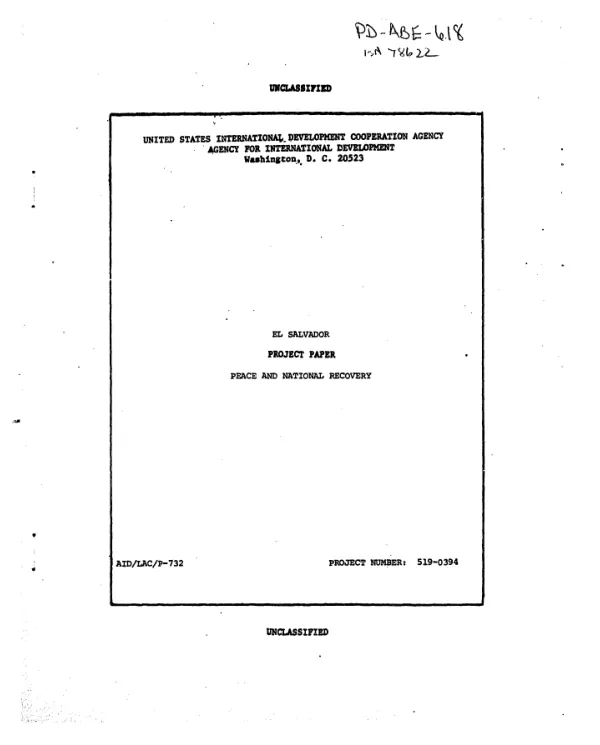
Peace and national recovery
Project to support national reconciliation in El Salvador by promoting social, economic, and political development in the conflictive zones (CZ"s), comprising 800,000 persons in 99 municipalities.
1992
Sign in to readA free account is required to download.
Abstract
The project, to be implemented by the Secretariat for National Reconstruction (SNR) and the Technical Secretariat for External Financing (SETEFE), has five components: immediate CZ relief; assistance to ex-combatants; social and economic CZ reactivation; land transfer; and restoration of public service infrastructure. Immediate CZ relief will begin after signing of the Peace Accord and will be financed from existing projects and ESF-generated local currencies. This component will: (1) provide cedulas (the official identification card required for voting, international travel, and access to government services) to the many civilians in the CZ"s who lack them; (2) aid in the distribution of World Food Program-donated emergency food to displaced families; (3) resupply Ministry of Health facilities; (4) support efforts of PVO"s, especially those active in the Displaced Persons Project (5190281), to extend humanitarian relief (e.g., shelter, employment, farm inputs) to displaced families; (5) support a comprehensive campaign to help the public to identify land mines and other unexploded ordnance; and (6) finance sociodemographic profiles to identify the needs of the targeted population and provide baseline data for the National Reconstruction Program. Ex-combatants from both sides will receive assistance through (1) social/economic reintegration counseling, including job training and help in securing loans and housing and starting small businesses; and (2) university scholarships for all disbanded officers who have served 4 years and meet academic criteria. The counseling program will be implemented by a PVO with funding from the Displaced Persons Project. Social and economic reactivation in the CZ"s will consume over 90% of the $166 million in new funds budgeted for this project. Specifically, this component will: (1) continue the Municipalities in Action program to help finance small-scale, municipal-level infrastructure (health posts, schools, roads, etc.); (2) support health and education services, including immunization campaigns, PVO maternal/child health activities, rehabilitation of the handicapped, and staffing of government education programs; and (3) develop productive enterprises via short-term vocational training, a job placement program, agricultural starter packets, and agricultural and microenterprise credit programs, including village bank programs for women. The National Reconstruction Plan will provide land, or credit to buy land, through government entities, including the Land Bank, the Institute for Agrarian Transformation (ISTA), the Land Registry Office (RPRH), and the National Geographic Institute (IGN). The Land Bank will be the primary financier of land in repatriated villages. Finally, the project will finance a modest portion (less than 10%) of the emergency repair and reconstruction of public service infrastructure, including electric power, water supply, telecommunications, highways, bridges, railroads, airports, and seaports. The project will help the Directorate General of Reconstruction manage this effort and will finance feasibility studies to promote other donors" involvement. Support to SNR and SETEFE in implementing the project will also be financed. Amendment of 3/8/93 increases funding a total of $50 million ($25 million in direct project funding, and $25 million from other USAID/ES projects and ESF-generated local currencies) and it reprograms the budget to provide more support to ex-combatant reintegration, the war wounded, land transfers, demobilization of the national police, reintegration counseling, scholarships for former combatants, training, agricultural credit, and other key elements of the Chapultepec Peace Accords and the National Reconstruction Program. It also budgets additional funds for priority needs (maternal health/child survival and village banks) under the social and economic reactivation component, and for infrastructure; it increases the number of targeted municipalities from 99 to 115. (PD-ABG-618)