USAID. MISSION TO EGYPT
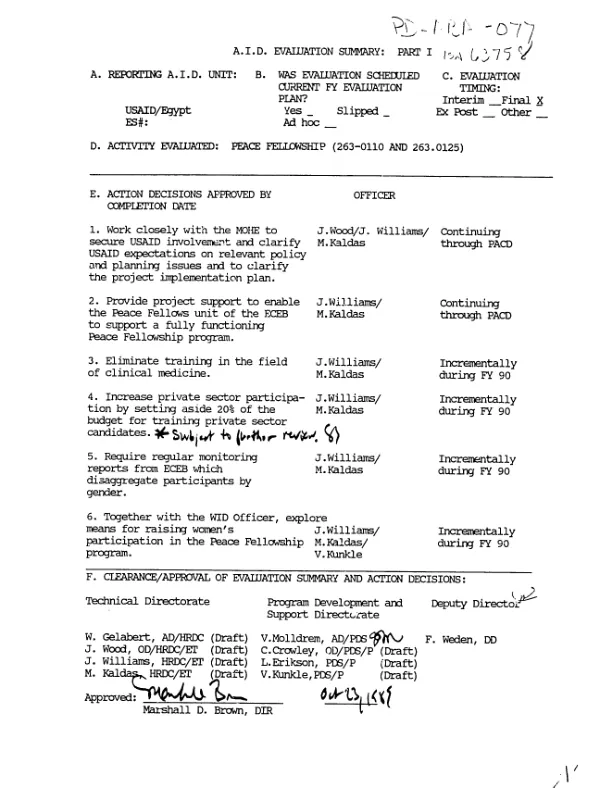
Peace fellowship program
Evaluates Peace Fellowship Program (PFP) to provide U.S.
Relpf, James F., Jr.; Swallow, John R. · 1983
Sign in to readA free account is required to download.
Abstract
graduate training to Egyptians working in fields pertinent to economic and social development. PES covers the period 5/81-10/83 and is based on document review, site visits, and interviews with Peace Fellows (PF"s), their supervisors, and representatives of Egyptian and U.S. organizations. The PFP is moving well toward the upwardly revised target of training 1,900 participants in U.S. schools. Nearly 650 PF"s are now in the U.S. and 504 have returned to Egypt. Much of the credit for the program"s success is due to the Egyptian leadership of the PFP, to good Egyptian-AID cooperation and flexibility in addressing operational problems, and to the excellent performance of the contractor, AMIDEAST. Two major strengths are AMIDEAST"s work in arranging PFs" attendance at professional/technical meetings, and the provision of professional journals after the PF"s return to Egypt. Nearly 27% of participants are women, vs. a targeted 35%. Returned PF"s are of good calibre and several have alrady made impressive, developmentally related contributions, utilizing knowledge gained in the U.S., and generating new knowledge; the majority returned to the same position held previously, but with more expectation of advancement. However, while PF"s sponsored by universities, research institutes, private companies and public companies (in descending order) see their training as very helpful, those sponsored by government agencies (the Ministry of Health being a notable exception) report little improvement in work situation. While the 21-month faculty upgrading part of the PFP is working smoothly, the 10-month variant has caused a number of management problems because of its uniqueness in concept, its time-consuming placement requirements, and because of the highly motivated Egyptian participants" determination to seek extensions so they can complete Master"s degrees. Recommendations include, inter alia, shifting from the present mix of 10- and 21-month fellowships toward a basic 12-month program, with extensions of up to 3 months.
Related documents