USAID DEC
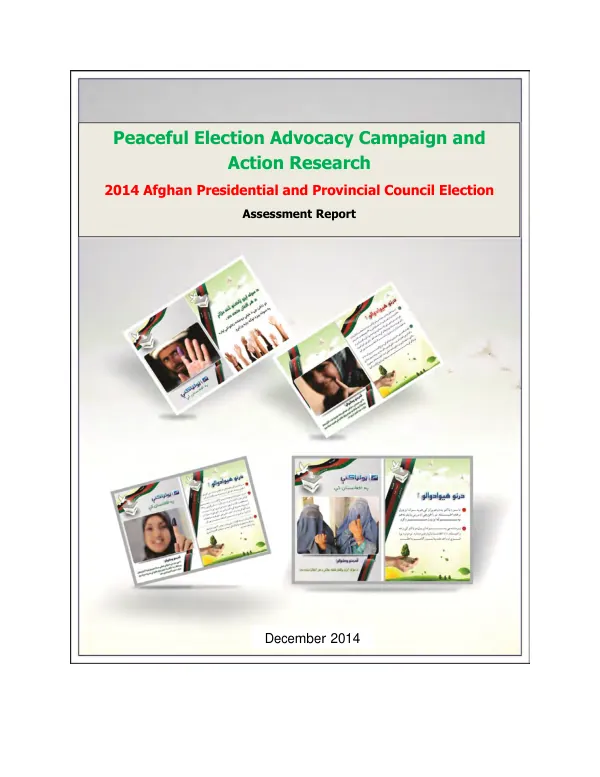
Peaceful Election Advocacy Campaign and Action Research 2014 Afghan Presidential and Provincial Council Election Assessment Report
Sign inCREATIVE ASSOCIATES INTERNATIONAL INC.
Peaceful Election Advocacy Campaign and Action Research 2014 Afghan Presidential and Provincial Council Election Assessment Report
The Community Cohesion Initiative (CCI) was a collaborative effort between Creative Associates International (Creative) and the Office of Transition Initiatives (OTI) to promote a peaceful 2014 electoral process in Afghanistan.
2014 · 33 pages
Sign in to readA free account is required to download.
Abstract
The initiative was part of the country objective "support peaceful electoral processes and outcomes." The CCI focused on five strategically important provinces: Kandahar, Hilmand, Ghazni, Khost, and Kunar, which were identified as being at a higher risk of electoral conflict or violence. The Peaceful Election Advocacy Campaign was a key component of the CCI, aimed at providing voter information and civic education to the target provinces. The campaign involved a collaborative effort with the U.S. Mission, the United Nations (UN), and the Independent Election Commission (IEC) to deliver a credible and peaceful election in Afghanistan. The campaign's activities included message design, message dissemination, provincial dialogues, radio and television, print materials, and face-to-face sessions. The campaign's impact was assessed through focus group research, face-to-face meetings, media footprint, and printed materials. The results showed that the campaign positively influenced Afghans to participate in elections while engaging in peaceful behavior. However, the project's activities did not cover the entire electoral cycle from pre-electoral planning through to the transition of power, and the messages disseminated were not evaluated within the changing context of the cycle. The Action Research component of the CCI involved mapping of electoral violence, research and analytical services, and program impact assessment. The research aimed to understand what "credible and legitimate" meant for the Afghan electorate and to identify valuable data to mitigate and prevent electoral violence. The project was successful in identifying security hot spots for electoral incidents, but the opportunity was missed to transfer that data to key electoral stakeholders, thus reducing the intended impact. The 2015 Electoral Conflict Profile was developed as an update to the 2012 electoral security assessment and provided the basis for future electoral programming in Afghanistan. The profile identified provinces at a higher risk of electoral conflict or violence and served as a guide for future initiatives to support peaceful electoral processes and outcomes. The key recommendation of this assessment report is to validate the data against other efforts to contribute to peaceful elections in Afghanistan and combine any future efforts with a more comprehensive set of activities to support peaceful electoral processes and outcomes. The 2014 Presidential and Provincial Council Elections and the June 14, 2014 Presidential Second Round elections saw an increase in participation relative to the 2010 elections and a relative calm at a majority of voting centers. However, the process was marred by numerous claims and at least some proof of fraud committed by key electoral stakeholders, and was only brought to a peaceful conclusion through a political settlement. The Independent Election Commission (IEC) made significant progress in organizing and conducting the electoral process, but technical irregularities and allegations of fraud culminated in an unprecedented full election audit and involvement by external political interests.