USAID DEC
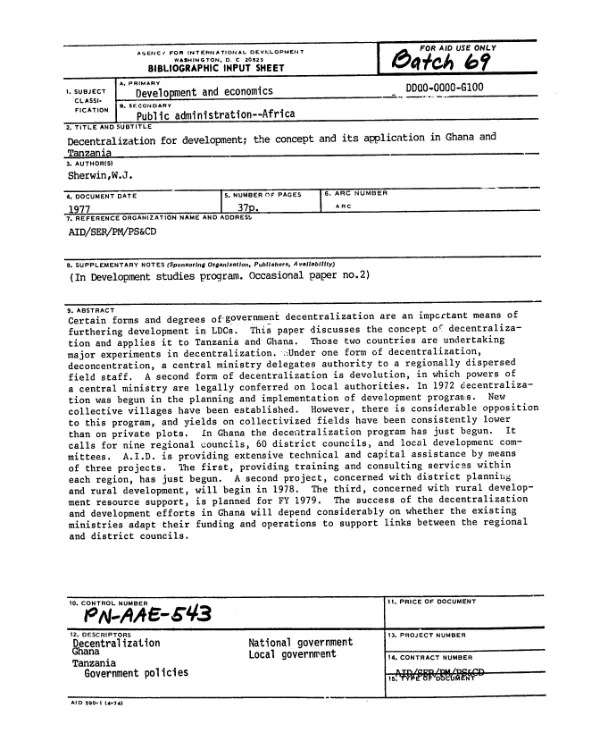
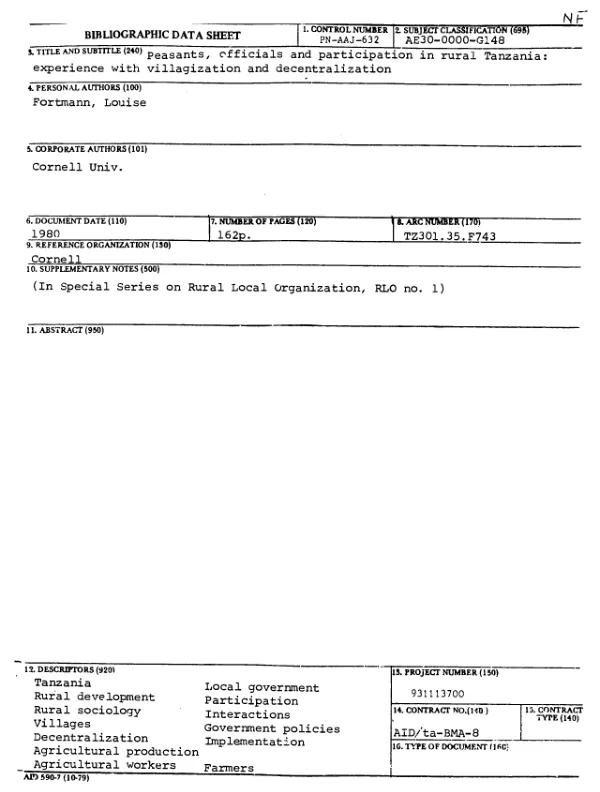
PEASANTS, OFFICIALS AND PARTICIPATION IN RURAL TANZANIA : EXPERIENCE WITH VILLAGIZATION AND DECENTRALIZATION
Sign inCORNELL UNIVERSITY
PEASANTS, OFFICIALS AND PARTICIPATION IN RURAL TANZANIA : EXPERIENCE WITH VILLAGIZATION AND DECENTRALIZATION
Tanzania has failed to realize its goals of participatory socialism and collective agricultural production.
FORTMANN, LOUISE P. · 1970
Sign in to readA free account is required to download.
Abstract
The fault lies with the definition and implementation of these policies by a central government bureaucracy structurally and attitudinally similar to its colonial antecedents. This report examines Tanzania"s colonial and post-independence bureaucracies in relation to the two conflicting driving forces of rural development: the need for genuine local decisionmaking to ensure a commitment to development programs and the need for central control to allocate scarce resources in a coherent nation-building strategy. The degradation of local government begun under German and British rule has continued into the present, with the peasantry excluded from all decisionmaking and subjected to programs encouraging only passivity and surplus production -- to the bureaucracy"s benefit. Efforts to ensure government accountability, such as decentralizing the bureaucracy, have had no impact. The peasantry has no voice in the development process, as the government ignores village councils and leaders and allows no debate on its policies. Peasant participation is thus gained through largesse or coercion, with the latter exemplified under Operation Vijiji, where the government forcibly relocated 11 million people to nucleated settlements. The peasantry can only bargain with officials; actively or passively resist unpopular policies; initiate local projects, forcing the government to finish them; or petition individual government leaders. The negative impact of this situation upon self-help projects and the ujamaa village program (which emphasizes communal agricultural production) has been substantial. Self-help project participation has fallen sharply, increasing project costs, and the ambitious ujamaa program has not worked, as the non-participatory cycle nurtured self-fulfilling prophecies of failure. The bureaucracy"s recent emphasis upon surplus production over the ujamaa program"s socialist aims and its reactivation of the hated colonial by-laws mandating development participation suggest that the aspirations which sustained Tanzania"s drive for independence have yet to be realized.