USAID DEC
Peer Recruitment Strategies for Female Sex Workers Not Engaged in HIV Prevention and Treatment Services in Côte d’Ivoire: Program Data Analysis
Sign inFHI 360
Peer Recruitment Strategies for Female Sex Workers Not Engaged in HIV Prevention and Treatment Services in Côte d’Ivoire: Program Data Analysis
The HIV epidemic in Côte d'Ivoire is characterized by a broadly generalized epidemic, with a disproportionate burden of HIV among key populations, including female sex workers.
2020 · 12 pages
Sign in to readA free account is required to download.
Abstract
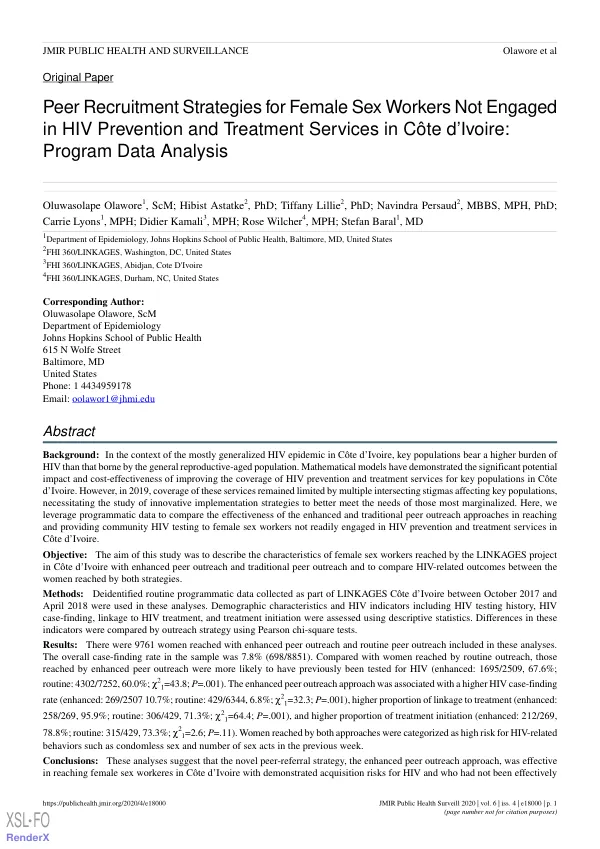
The estimated HIV prevalence among female sex workers is 7.5%, compared to 3.3% among women of reproductive age. Mathematical models have demonstrated the significant potential impact and cost-effectiveness of improving the coverage of HIV prevention and treatment services for key populations in Côte d'Ivoire. In 2019, coverage of HIV prevention and treatment services remained limited by multiple intersecting stigmas affecting key populations. A systematic review assessing the uptake of HIV testing among female sex workers found that factors such as cost, time in accessing healthcare facilities, HIV testing policy shortcomings in confidentiality, and cost of healthcare impact uptake. Additionally, policies that specifically criminalize key populations and intersectional stigmas have resulted in limited coverage of these services among key populations. Addressing the HIV epidemic among key populations has been demonstrated to represent an essential and cost-effective component for the overall HIV response, particularly in the context of declining HIV funding in the country. Differentiated HIV service delivery approaches aim to be client-centered and reduce the burden on the health system. Elements of differentiated care include tailoring service frequency and intensity to the needs of clients, offering services in a range of locations, and task shifting services to different types of providers, including lay and peer providers who may themselves be members of key population communities. In Côte d'Ivoire, differentiated care models have mainly been used for decentralizing care for individuals stable on antiretroviral therapy or for antiretroviral therapy delivery. However, differentiated care may also be applied to different steps along the HIV care continuum. Community-based and peer-driven approaches have been used to meet and serve key population community members in environments that facilitate disclosure of key population-status and uptake of services by reducing stigma associated with accessing healthcare at facilities. A study conducted in Côte d'Ivoire used programmatic data to compare the effectiveness of enhanced and traditional peer outreach approaches in reaching and providing community HIV testing to female sex workers not readily engaged in HIV prevention and treatment services. The study found that the enhanced peer outreach approach was associated with a higher HIV case-finding rate, higher proportion of linkage to treatment, and higher proportion of treatment initiation compared to the traditional peer outreach approach. The enhanced peer outreach approach also reached female sex workers with demonstrated acquisition risks for HIV who had not been effectively engaged by routine outreach approaches. The study suggests that scaling up novel strategies such as enhanced peer outreach in the context of differentiated service models may be needed to optimize HIV prevention and treatment outcomes for key populations in Côte d'Ivoire. Community-led peer education, condom distribution, and STI/HIV screening and treatment have all demonstrated impact in addressing traditionally marginalized communities at high risk of HIV. Other studies have consistently shown that community-led programs that incorporate biomedical, behavioral, and structural approaches can support improved prevention and treatment outcomes.