USAID DEC
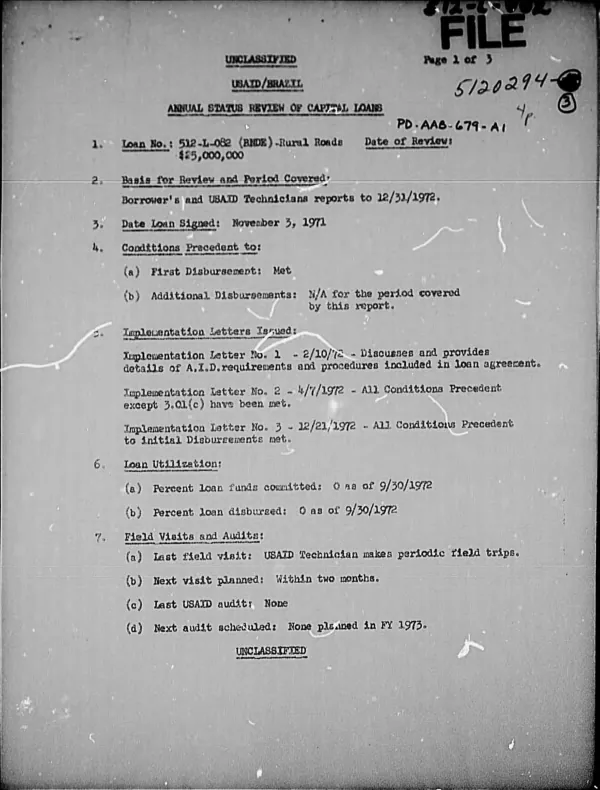
Percen loa~n ands Ittd Field Visits and Audits: I (c a USAe2A audit8 11AX onea ud~b
The agricultural development initiative in Brazil began in 1975 with funding from the United States Agency for International Development (USAID) through a loan of $12.1 million.
4 pages
Sign in to readA free account is required to download.
Abstract
The loan was part of the Agency for International Development (AID) program to support agricultural development in the country. The project focused on improving agricultural productivity and income for small farmers in the states of Mato Grosso, Goiás, Paraná, Alagoas, and Pernambuco. The loan was used to finance various activities, including the purchase of agricultural equipment, the construction of irrigation systems, and the provision of technical assistance to farmers. The project also included a component for the development of rural infrastructure, such as roads and storage facilities. The loan was disbursed in several installments, with the first disbursement of $4.3 million made in 1975. The project was implemented in several stages, with the first stage focusing on the development of agricultural infrastructure, including the construction of irrigation systems and the purchase of agricultural equipment. The second stage involved the provision of technical assistance to farmers, including training programs and the distribution of improved seeds and fertilizers. The project also included a component for the development of rural infrastructure, such as roads and storage facilities. The project had a significant impact on agricultural productivity and income for small farmers in the participating states. The project helped to increase crop yields and improve the quality of agricultural products, leading to increased income for farmers. The project also helped to improve the overall economic situation in the participating states, with the creation of new jobs and the stimulation of local economic activity. The project was implemented over a period of several years, with the first stage completed in 1977 and the second stage completed in 1979. The project was successful in achieving its objectives, with significant improvements in agricultural productivity and income for small farmers in the participating states. The project also helped to improve the overall economic situation in the participating states, with the creation of new jobs and the stimulation of local economic activity.