DAI GLOBAL, LLC
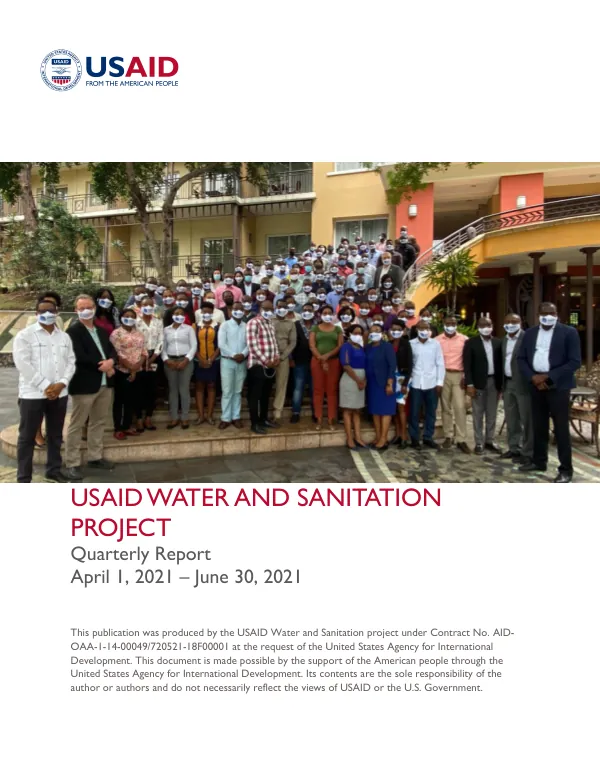
USAID Water and Sanitation Project Quarterly Report April 1, 2021 – June 30, 2021
The USAID Water and Sanitation Project is a $41.8-million, 4.5-year activity implemented in collaboration with Haiti's National Directorate of Potable Water and Sanitation (DINEPA) with the overall goal of improving sanitation and water for all Haitians.
2021 · 34 pages
Sign in to readA free account is required to download.
Abstract
The Project is now focused on ten geographic areas, including the original five areas: Cap-Haïtien, Mirebalais, Croix des Bouquets, Les Cayes, and Jérémie, as well as five areas that have been added over the last year: Ouanaminthe, Hinche, Pignon, Belladère, and Lascahobas. The Project's three primary goals are to help 250,000 people get to basic or improved access to water, help 75,000 people get access to basic or improved sanitation, and lay the foundation for sustainable increases in access to water and sanitation across Haiti. The Project is reaching these goals by focusing on its core values such as self-reliance, resilience, and the private-sector approach. During this quarter, the Project expanded its approach to include three additional water systems: Belladère, Lascahobas, and Pignon. It held a national level workshop bringing together all the CTEs in Haiti to talk about best practices in managing water systems, and it published the drafts of most of the sections of the CTE Operations Manual. The Project has provided basic access to water to 13,240 people and is providing improved water service to 177,210 people, resulting in a total of 190,450 people—an increase of over 17,495 people since last quarter. The project activities under Component I are focused on providing basic or improved water to 250,000 people by building the capacity of the CTEs and their support structures to provide water on a sustainable basis. The Project also funds infrastructure improvements that serve to make the systems more reliable and less expensive to operate. The Project was able to begin working with three additional water systems: the Belladère and Lascahobas systems in the OREPA Center and the Pignon system in the OREPA North. Belladère is in the Central Plateau on the border with the Dominican Republic. The OREPA promoted the management unit for the water system from being a volunteer committee, a CAEPA, to a CTE. The Project began working with this CTE during this quarter. A joint OREPA and Project team undertook an assessment of the operational situation of the Belladère CTE to determine how the CTE could provide more water to more people. The assessment revealed that the main issue is the CTE's management, not its infrastructure. The Project will focus on helping the CTE to organize its management of the water system, including developing and managing its customer list, developing a schedule for water delivery, and treating the water system as a business. Lascahobas operated as a CAEPA-managed system until 2009. In 2009, a major reform of the water and sanitation sector occurred to decentralize the management of the water sector. The Lascahobas CAEPA became a CTE (known as a local water utility). However, as with most CTEs, they have not been formally trained to operate on a cost-recovery basis. The regional water authority (known as the OREPA) asked for USAID's assistance to help the CTE better manage its water system. The Project will work with the CTE to improve its management and provide more water to more customers. The Project has made significant progress in increasing access to water and sanitation services in Haiti. The Project has provided basic access to water to 13,240 people and is providing improved water service to 177,210 people, resulting in a total of 190,450 people—an increase of over 17,495 people since last quarter. The Project has also begun working with three additional water systems: the Belladère and Lascahobas systems in the OREPA Center and the Pignon system in the OREPA North. The Project's focus on building the capacity of the CTEs and their support structures to provide water on a sustainable basis has been successful. The Project has also funded infrastructure improvements that serve to make the systems more reliable and less expensive to operate. The Project's work with the CTEs has helped to improve the management of the water systems, including developing and managing customer lists, developing schedules for water delivery, and treating the water systems as businesses. The Project's progress in increasing access to water and sanitation services in Haiti is a significant step towards achieving the Project's overall goal of improving sanitation and water for all Haitians. The Project's focus on building the capacity of the CTEs and their support structures to provide water on a sustainable basis has been successful, and the Project's work with the CTEs has helped to improve the management of the water systems.