DELOITTE CONSULTING, LLP
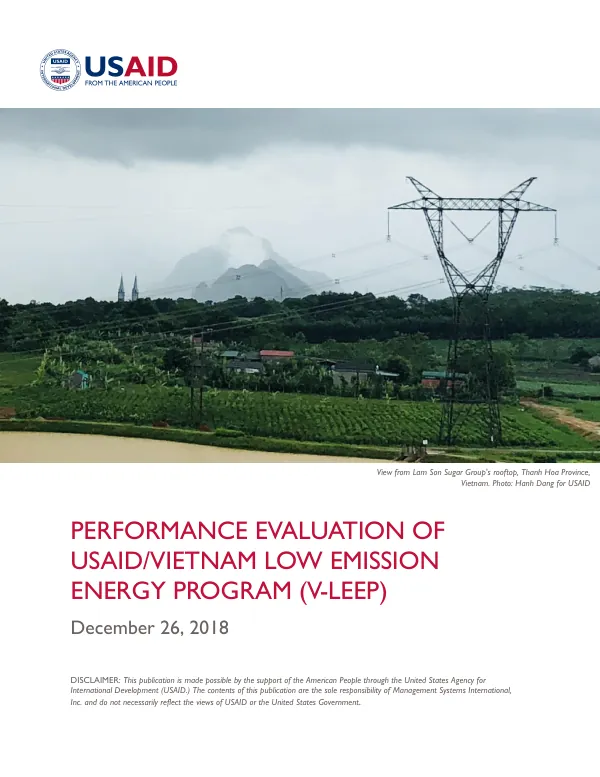
Performance Evaluation of USAID/Vietnam Low Emission Energy Program (V-LEEP)
The USAID/Vietnam Low Emission Energy Program (V-LEEP) is a program designed to assist the Government of Vietnam (GVN) in establishing an effective policy, regulatory, and incentive environment for low emission growth in the energy sector.
2018 · 141 pages
Sign in to readA free account is required to download.
Abstract
The program, implemented by Deloitte Consulting LLP, commenced on October 2015 and is expected to operate through September 1, 2020, with a contract value of $9,373,706. Three components form the core of V-LEEP: Low Emission Strategy Development for the Energy Sector, Enhance Capacity and Improve the Enabling Environment for Renewable Energy Development, and Increase Energy Efficiency Adoption and Compliance. The program's objectives are to promote low emission growth in the energy sector, attract public- and private-sector investment in renewable energy, and improve energy efficiency. To achieve these objectives, V-LEEP has been working with various stakeholders, including government counterparts, private sector companies, and international donors. The program has also been implementing various activities, such as capacity building, policy development, and infrastructure development, to support the growth of renewable energy and energy efficiency in Vietnam. The evaluation of V-LEEP was conducted to review the program's progress towards achieving its objectives and to determine if the program's objectives and work plan should be adjusted. The evaluation found that most V-LEEP activities are still in nascent stages due to delays in ODA approval from the GVN and the restructuring of the Ministry of Industry and Trade (MOIT). There is very little progress on the achievement of indicators, and the evaluation team believes that the results are achievable within the remaining period of performance. The evaluation team identified a need for the upcoming work plan to refocus the technical staff and budget on the high priority results. These results, marked in blue, are considered critical to the program's success and require intensive technical assistance and financial resources. Once these results have been prioritized, the results marked in gray should be considered, as they have potential for progress but require additional resources and attention. The evaluation team also found that the theory of change interventions are leading to the desired program outcome, but there is a need for clarity of linkages between inputs, outputs, results, and outcomes. The evaluation team believes that the theory of change is still relevant to GVN policies, plans, and priorities, but there is a need for further refinement and alignment with the GVN's development plans. The evaluation team identified several driving factors influencing or inhibiting progress to date, particularly in the renewable energy sector and energy efficiency sectors. These factors include delays in ODA approval, restructuring of MOIT, and lack of clarity on the theory of change. The evaluation team also identified several lessons learned and characteristics of successful activities that could be replicated in other sectors or programs. Overall, the evaluation of V-LEEP found that the program has made progress in promoting low emission growth in the energy sector, but there is a need for refocusing the technical staff and budget on high priority results. The evaluation team believes that with intensive technical assistance and financial resources, the program can achieve its objectives and make a significant impact on the growth of renewable energy and energy efficiency in Vietnam. The evaluation team employed a mixed-methods approach using predominately qualitative primary data. Data collection methods included document review and key informant interviews with government counterparts, private sector companies, V-LEEP staff, USAID, and other stakeholders. The evaluation team found that the key milestones developed by the partner track progress towards achieving high-level results, but there is a need for further refinement and alignment with the GVN's development plans. The evaluation team identified several recommendations for the upcoming work plan, including refocusing the technical staff and budget on high priority results, providing intensive technical assistance and financial resources, and refining and aligning the theory of change with the GVN's development plans. The evaluation team also recommended that the program continue to work with various stakeholders, including government counterparts, private sector companies, and international donors, to support the growth of renewable energy and energy efficiency in Vietnam.