CARE
Performance Report
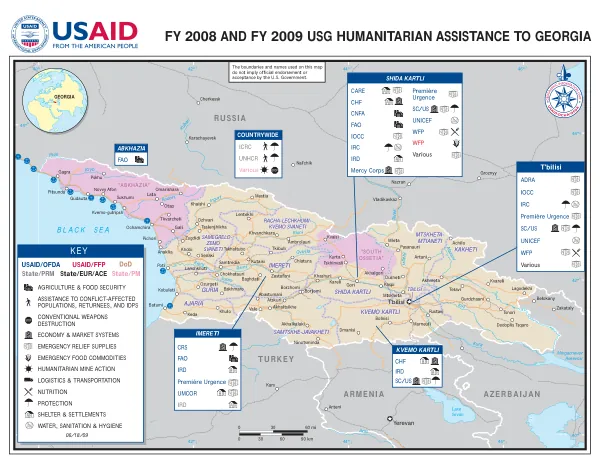
The Emergency Supply of Animal Feed to Conflict Affected Small Scale Farming Households and Support to the Agriculture Sector and Food Security Cluster Coordination in Georgia project began on October 15, 2008, with a budget of US$5,500,000.
2009 · 8 pages
Sign in to readA free account is required to download.
Abstract
The project aimed to protect the livelihoods of vulnerable livestock holders in conflict-affected areas and provide technical assistance and coordination support to ensure that the affected population accrues greater benefits from all related rural household food security interventions. The project's overall objective is to protect the livelihoods of vulnerable livestock holders in conflict-affected areas and provide technical assistance and coordination support to ensure that the affected population accrues greater benefits from all related rural household food security interventions. The immediate objectives of the project are to ensure the survival of up to 12,000 livestock by distributing concentrated animal feed to the most vulnerable small-scale farmers affected by the conflict and to ensure that a coherent and technically sound agricultural assistance programme for the region is implemented through coordination of NGOs and UN agencies involved in emergency agricultural relief operations in Georgia. The project has made significant progress in achieving its objectives. The Emergency Rehabilitation Coordination Unit (ERCU) of the Food and Agriculture Organization of the United Nations (FAO) became operational in early January 2009, and currently comprises four international staff and 10 national staff, operating out of Tbilisi and Gori. Emergency distribution of 4,240 MT of concentrated animal feed in conflict-affected areas of Shida Kartli Region was completed by March 31, 2009, with cattle de-worming to be concluded in April and May. The project has also established an inter-agency coordination agreement to strengthen the humanitarian response, and FAO continues to co-chair the Food Security Cluster (FSC) in Georgia together with the World Food Programme. Coordination of agricultural activities through the cluster approach remains important during the transition from emergency to rehabilitation phases, ensuring that the recovery of rural livelihoods and food security are properly addressed. The project has also started collating information on agriculture-related activities and projects across Georgia, and will make this information available to other FSC members in coming weeks and months. In addition, the Georgian Ministry of Agriculture was invited by the FAO Representative to Georgia to engage in a national consultative process to develop a National Medium Term Priority Framework (NMTPF) for Georgia, the planning and management tool of FAO assistance to member countries. The project has also procured project inputs in full compliance with FAO procurement rules and regulations. The supply of concentrated animal feed was determined as a result of international competitive tendering, with three separate companies invited to provide concentrated animal feed meeting FAO technical specifications. The concentrated animal feed supplied by the project meets the technical specifications determined by FAO's animal health and production experts to provide improved nutrition to cattle. The project has also established Letters of Agreement with selected implementing partners, including CARE International, World Vision, International Orthodox Christian Charities, and Save the Children, to implement activities including beneficiary identification, distribution of feed according to agreed plans, endoparasitic treatment of cattle belonging to most vulnerable farmer households, and emergency water trough construction to secure adequate water supply for livestock. Beneficiary identification and distribution criteria were based on procedures developed by the Food Security Cluster. The FSC, in conjunction with key implementing partner NGOs, developed harmonized criteria in October 2008 for use on the ground. In addition, special community-level commissions have been created to identify beneficiaries for both farmer-related support and humanitarian aid. The project has distributed 4,240 MT of concentrated animal feed to a total of 18,248 beneficiaries in 127 villages in Shida Kartli Region by March 31, 2009. The first round of cattle de-worming in the conflict-affected area is ongoing and is expected to be completed by April 30, 2009, with more than 35,000 head of cattle treated. The second round of de-worming, to ensure that cattle reintroduced to common grazing and pastureland are not reinfected, is expected to finish by the end of May 2009.
Related documents