WORLD BANK
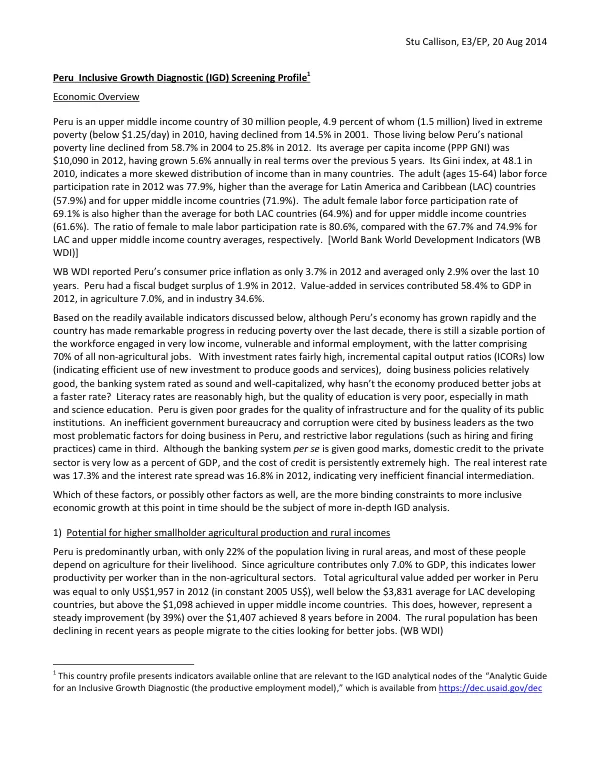
Peru Inclusive Growth Diagnostic (IGD) Screening Profile
Peru's economic growth has been rapid, with a 5.6% annual increase in real terms over the previous 5 years, resulting in an average per capita income (PPP GNI) of $10,090 in 2012.
2014 · 15 pages
Sign in to readA free account is required to download.
Abstract
The country has made significant progress in reducing poverty, with the percentage of the population living below the national poverty line declining from 58.7% in 2004 to 25.8% in 2012. However, despite this progress, a sizable portion of the workforce remains engaged in very low-income, vulnerable, and informal employment, with 70% of non-agricultural jobs falling into this category. Peru's economy is characterized by a high investment rate and low incremental capital output ratios (ICORs), indicating efficient use of new investment to produce goods and services. The banking system is rated as sound and well-capitalized, and doing business policies are relatively good. However, literacy rates are reasonably high, but the quality of education is poor, particularly in math and science. Peru is also given poor grades for the quality of infrastructure and public institutions, with an inefficient government bureaucracy and corruption cited as major obstacles to doing business. Agriculture contributes only 7.0% to GDP, indicating lower productivity per worker than in non-agricultural sectors. Total agricultural value added per worker in Peru was $1,957 in 2012, well below the average for Latin American and Caribbean (LAC) developing countries but above the average for upper middle-income countries. The rural population has been declining in recent years as people migrate to cities in search of better jobs. Despite this, agricultural value-added per worker has increased, and the agricultural employment share of total employment has declined. Peru's agricultural sector has shown steady improvement, with total crop production increasing by 36% between 2004-2006 and 2012, and livestock production increasing by 48% over the same period. However, agricultural land has increased by only 0.7% between 2004-06 and 2011, and arable land has remained unchanged. The EIU Global Food Security Index indicates that Peru spends only 1% of the agricultural contribution to GDP on agricultural research and development, placing it in the bottom 40% of the 105 countries covered. The country's potential for higher smallholder agricultural production and rural incomes is significant, with the rural population having been declining in recent years as people migrate to cities in search of better jobs. However, the quality of education, particularly in math and science, is a major constraint to agricultural productivity and growth. The World Bank Doing Business Indicators 2014 gave Peru a very good score for registering property, ranking 22 out of 189 countries. Peru's potential for more productive, higher-wage non-farm employment is also significant, with adult labor force participation rates being fairly high. However, the investment climate for creating more productive jobs presents a mixed picture, with Peru ranking 42 out of 189 countries in the World Bank 2014 Doing Business Report. The country's ease of doing business is high, but it ranks low in dealing with construction permits, enforcing contracts, and resolving insolvency.