PLANNING AND DEVELOPMENT COLLABORATIVE INTERNATIONAL, INC. (PADCO)
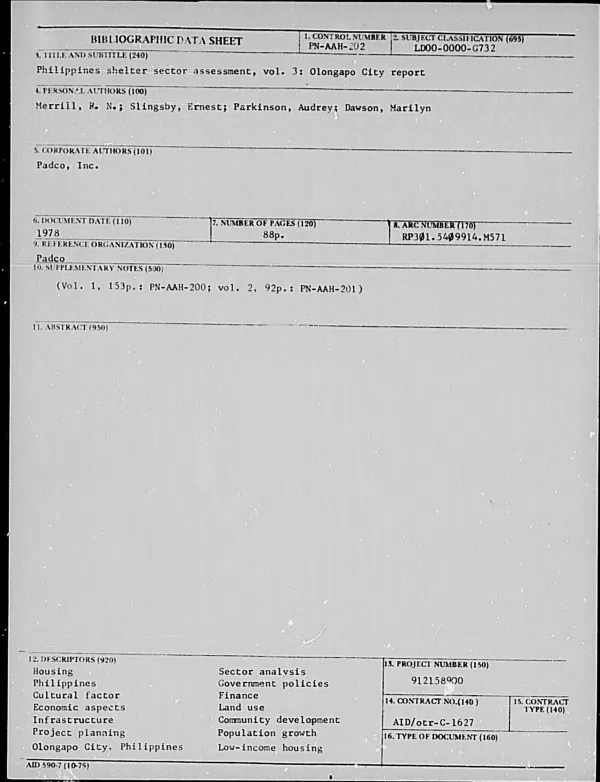
PHILIPPINES SHELTER SECTOR ASSESSMENT, VOL. 2 : ANGELES CITY REPORT
This is the second of three volumes reporting on a study to develop information and make recommendations relating to the shelter sector (defined broadly as including housing, land, infrastructure, utilities, social services, and employment opportunities) in the Philippines.
MERRILL, R. N.; SLINGSBY, ERNEST A. · 1970
Sign in to readA free account is required to download.

Abstract
The report presents an analysis of shelter needs in Angeles City and the constraints in resolving these needs. It first provides an overview of the city, its population trends, government structure, economy, finance, and income distribution. The dimension of its shelter problem is gauged by analyzing the present supply versus demand, human settlement patterns, and the socioeconomic characteristics of the low-income population. Components of the shelter problem such as land, infrastructure, utilities and finance are then reviewed. Based on the foregoing findings, the final section sets out alternative shelter approaches and possible projects designed to meet the shelter needs of lower-income groups. The criteria used to evaluate these alternative solutions are: affordability for project beneficiaries, replicability by cities on a national scale, institutional development, and consistency with national shelter policies. A summary of recommendations in the areas of comprehensive community improvement, sites and services, socioeconomic programs for the urban poor, institution building, and technical assistance precede the main text. Included among these are the provision of roads and footpaths, potable water supply, improved drainage and sanitation systems, necessary community facilities, and housing improvement loans to regularize and improve depressed city districts and to expand the resettlement scheme for low-income working families. Improved primary health care delivery services, upgraded social service agencies, and the introduction of cottage industries using home craftsmen/assemblers are also encouraged. Some 30 tables, maps and figures and four appendices giving a list of persons interviewed, cost breakdowns for implementing the recommendations, zoning classifications, and criteria subclassifications for zoning purposes are also included.