USAID DEC
Phylogeography of Muller's termite frog suggests the vicariant role of the Central Brazilian Plateau
Sign inUSAID DEC
Phylogeography of Muller's termite frog suggests the vicariant role of the Central Brazilian Plateau
The Central Brazilian Plateau in South America is a region of significant geological and ecological importance.
2018 · 2 pages
Sign in to readA free account is required to download.
Abstract
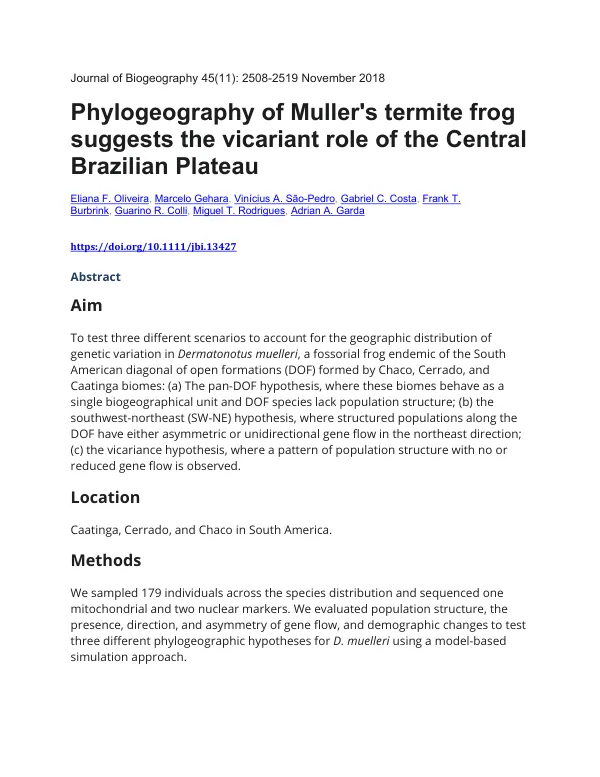
The plateau's formation is believed to have played a crucial role in shaping the phylogeography of various species, including the Muller's termite frog, Dermatonotus muelleri. This study aimed to investigate the genetic diversity of D. muelleri across its range, which spans the diagonal of open formations (DOF) in South America, including the Caatinga, Cerrado, and Chaco biomes. A total of 179 individuals were sampled across the species' distribution and subjected to genetic analysis. The results revealed two distinct lineages with no gene flow, contradicting the pan-DOF hypothesis. The Southwest lineage was found in the Chaco and western Cerrado regions, while the Northeast lineage was present in the eastern Cerrado and Caatinga regions. The study's findings support the vicariance model, which suggests that the Central Brazilian Plateau acted as a barrier to gene flow between the two lineages. The estimated divergence time for the two lineages was approximately 4 million years ago, during the Neogene orogeny in central Brazil. This event is believed to have led to the splitting of the Dermatonotus lineages. The study also suggests that Pleistocene climatic fluctuations may have had a limited impact on the population dynamics of the Northeast lineage. The results indicate that both ancient and recent events have shaped the phylogeography of Dermatonotus. The study's findings have significant implications for our understanding of the evolutionary history of D. muelleri and the role of the Central Brazilian Plateau in shaping the species' genetic diversity. The presence of a cryptic, undescribed species in the region highlights the need for further research into the biodiversity of the DOF. The study's results also underscore the importance of considering the complex interactions between geological and ecological processes in shaping the phylogeography of species. The genetic analysis of D. muelleri revealed a lack of gene flow between the two lineages, indicating that they have been isolated for a significant period. The Southwest lineage showed no demographic changes, while the Northeast lineage exhibited demographic changes, suggesting that it has been influenced by recent events. The study's results support the vicariance model, which suggests that the Central Brazilian Plateau acted as a barrier to gene flow between the two lineages. The study's results suggest that the Central Brazilian Plateau played a crucial role in shaping the phylogeography of D. muelleri. The plateau's formation is believed to have led to the isolation of the two lineages, which have since evolved independently. The study's findings have significant implications for our understanding of the evolutionary history of D. muelleri and the role of the Central Brazilian Plateau in shaping the species' genetic diversity.
Related documents