USAID DEC
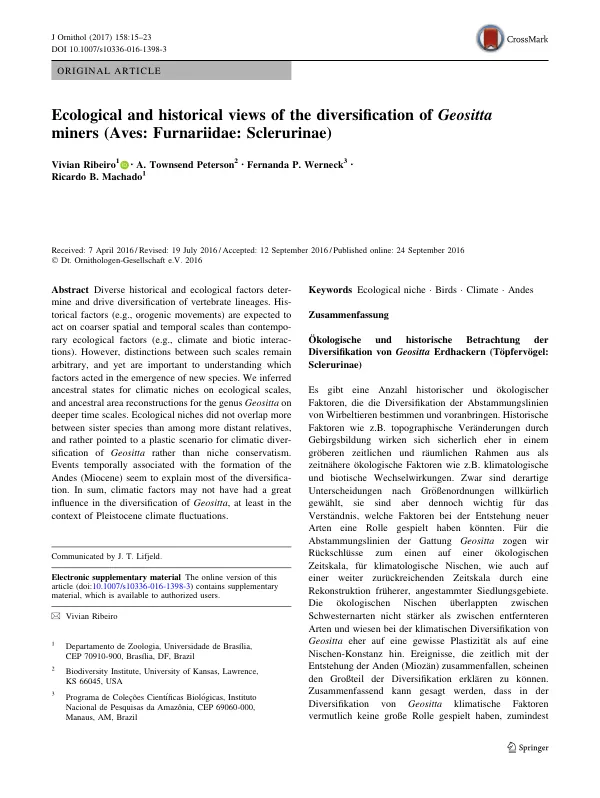
Ecological and historical views of the diversification of Geositta miners (Aves: Furnariidae: Sclerurinae)
Sign inUSAID DEC
Ecological and historical views of the diversification of Geositta miners (Aves: Furnariidae: Sclerurinae)
The evolutionary history of climatic niches is an emerging focus in ecology and biogeography.
2017 · 9 pages
Sign in to readA free account is required to download.
Abstract
This field of study is motivated by discussions about possible roles of ecological divergence in speciation processes and impacts of climate change on biodiversity. Understanding the evolution of climatic niches sets the stage for understanding how past climate change influenced and generated current biodiversity, and how biodiversity can be influenced by future climate change. Phyloclimatic analysis combines phylogenetic inferences with models characterizing environmental distributions of the taxa under study. This approach makes it possible to investigate how species of the same clade came to occupy distinct areas, or how distinct clades occupied the same area. Ecological niche models (ENMs) are central to phyloclimatic studies, as the association of the ENMs with phylogenetic information makes it possible to analyze influences of components of fundamental niches of species (e.g., climate variables) in speciation. Among vertebrates, birds are the best-studied major taxonomic group, which makes for abundant information about their biology and natural history, including large quantities of accessible occurrence records. The genus Geositta (Aves: Furnariidae: Sclerurinae) is distributed in central, western, and southern South America, with 9 of 11 species distributed in the Andean region between Ecuador and Argentina. Two species occur outside the Andes: one is restricted to the Cerrado in central South America (G. poeciloptera) and one in the dry Patagonian steppe (G. antarctica). The stem diversification of Geositta dates to around 19 million years ago, with pronounced diversification of extant species (the crown clade) beginning 14 million years ago, and most recent splits in the group dating to about 3.9 million years ago. This temporal scenario differs from previous propositions, which envisioned that G. cunicularia and G. antarctica originated only 14,000 years ago. The hypothesis of Pleistocene climatic fluctuations driving diversification of vertebrates, including Geositta, has received considerable attention, yet this hypothesis does not appear to apply to this group. The hypothesis that orogenic movements in the Andean chain acted in promoting diversification has been suggested many times, including for avian groups. Chaves et al. (2011) examined congruence between the phylogeny of hummingbirds and uplift events, and found a close temporal correspondence. The same pattern could be expected for Geositta given that its diversification appears to be older than the Pleistocene, and several of its species have distributions associated with or limited by the Andean region. To investigate the variation of climatic niches and geographic distributions through the evolutionary history of the group, we characterized the climatic niche of each species in the genus, tested geographic and environmental overlap between species, evaluated occupation trends in terms of climatic space over time, and elucidated ancestral distributional areas for Geositta species. We assembled occurrence points from the Global Biodiversity Information Facility and the speciesLink portal, and compared points with distributional maps from BirdLife International and Nature Serve to remove outliers as likely errors. We obtained climatic data from WorldClim that represent 1950-2000 climate averages, using 15 variables: 9 related to temperature and 6 related to precipitation. We set aside 10 points chosen at random for each species to permit model evaluation. The results of our analysis will provide insights into the evolution of climatic niches and geographic distributions of Geositta species, and will contribute to our understanding of the role of climatic variation and historic events in shaping the diversification of this group.
Related documents