USAID DEC
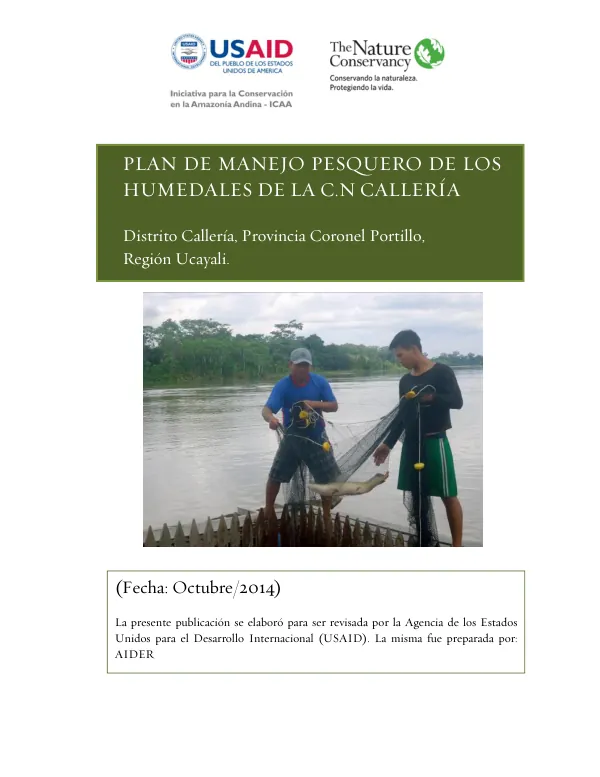
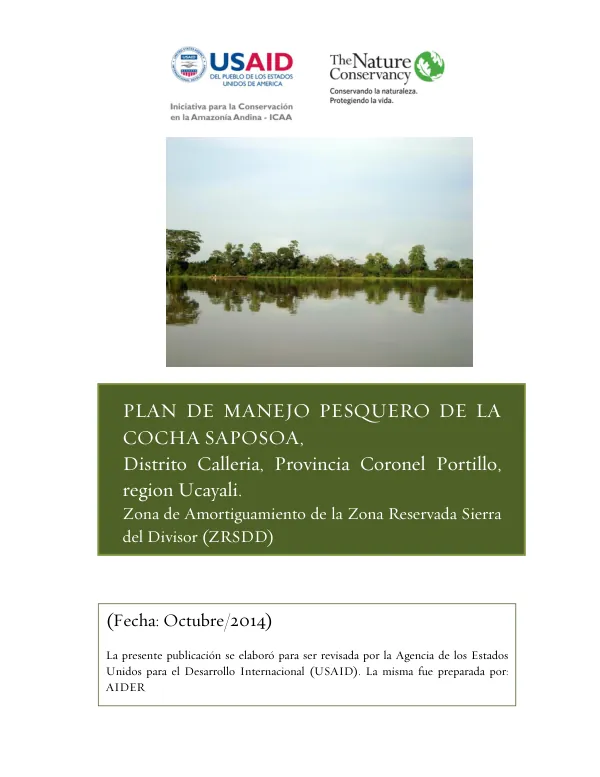
Plan de Manejo Pesquero de la Cocha Saposoa, Distrito Calleria, Provincia Coronel Portillo, Region Ucayali
Sign inAIDER
Plan de Manejo Pesquero de la Cocha Saposoa, Distrito Calleria, Provincia Coronel Portillo, Region Ucayali
The Amazonía peruana is characterized by its mega-biodiversity, particularly of forest and aquatic resources that have been the main resources for indigenous populations for years and now constitute important resources for local development.
2014 · 41 pages
Sign in to readA free account is required to download.
Abstract
The río Ucayali is the largest ictiológico basin and therefore the largest source of fish resources that supply the Amazonian population with the main source of protein. In the area of influence of this basin, there are a large number of cochas and natural water bodies generated by the constant fluctuations of its course, and its richness is due to its proximity to the Cordillera de los Andes, which provides year after year the necessary nutrients that justify this richness. In these aquatic ecosystems, there are more than 300 species of fish, of which around 70 are used for human consumption. Fish not only constitute the main source of protein for riverine populations, but also for developing other productive activities such as artisanal fishing, sport fishing, and ornamental fishing (the latter is little developed in Ucayali). However, fishing in the Peruvian Amazon, despite being concentrated in no more than 20 species, is generating problems due to the pressure of fishing on species of greater demand in the market, causing overexploitation of the resources, to limits that threaten their own survival. This is the situation of the "paiche", the largest freshwater fish in the Amazon, of the "arahuana", "taricaya", among other aquatic resources present in the area. The indiscriminate fishing is causing the decrease of the fishing volumes, which means that the fishermen have to move to greater distances and invest more time and money to obtain the same amount of fish compared to previous years. In view of this problem, it is necessary to increase the efforts of the fishing sector to make the activity sustainable over time; within its efforts, this is the application of ordering measures, as well as vigilance and control, which requires the inter-institutional action of the sectors committed to the generation of information and the management of the fishery resources; all these actions have to contemplate the labor of education, which motivates the users to take care of the exploited resources. The Plan de Manejo Pesquero or Plan de Manejo Pesquero (MAPE) is a technical and administrative instrument subsidiary to the Reglamento de Ordenamiento Pesquero de la Amazonía Peruana (RM 147-2001-PE), and its objective is to put into practice a controlled exploitation of a species or a set of species in a particular environment, under norms and regulations monitored periodically. Therefore, the present proposal aims to manage eight hydrobiological species susceptible to irrational exploitation, carrying out the sustainable use of these resources with social, economic, and environmental benefits, which justifies its execution. The legal framework for the management of fishery resources in the Peruvian Amazon is established by the following laws and regulations: the Constitution of Peru, the Organic Law for the Sustainable Use of Natural Resources (Law No. 26821, June 10, 1997), the Law on Protected Areas (Law No. 26834, June 30, 1997), the Law on the Conservation and Sustainable Use of Biodiversity (Law No. 26839, July 16, 1997), the General Law on Fishing (Decree-Law No. 25977, December 21, 1992), and its Regulation (Supreme Decree No. 012-2001-PE, March 13, 2001), and the Reglamento de Ordenamiento Pesquero de la Amazonía Peruana (Supreme Decree No. 015-2009-PRODUCE, April 30, 2009). These laws and regulations establish the principles and guidelines for the sustainable use of fishery resources, the protection of the environment and biodiversity, and the promotion of social and economic development in the Amazon region.