USAID DEC
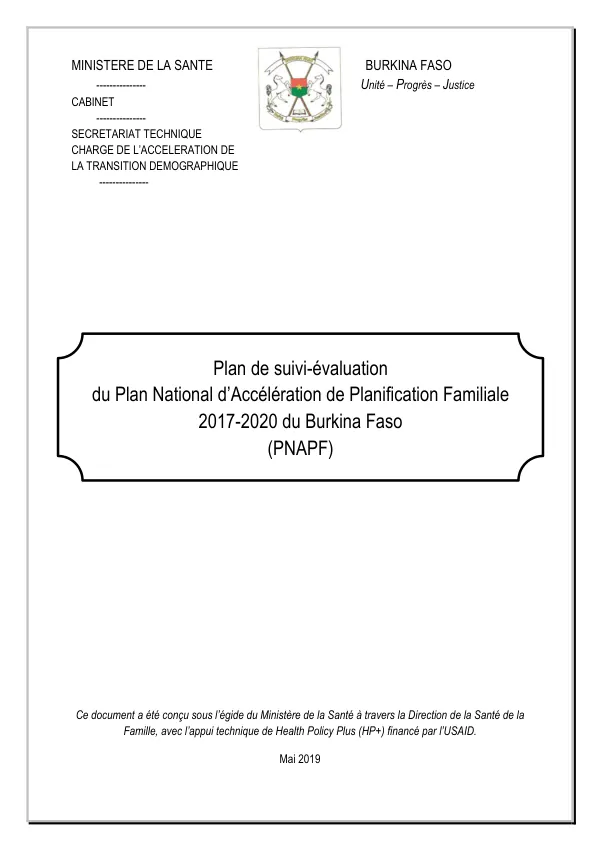
Plan de suivi-évaluation du Plan National d’Accélération de Planification Familiale 2017-2020 du Burkina Faso
Sign inHEALTH POLICY PLUS
Plan de suivi-évaluation du Plan National d’Accélération de Planification Familiale 2017-2020 du Burkina Faso
The Plan National d'Accélération de la Planification Familiale (PNAPF) 2017-2020 is a national plan aimed at accelerating family planning in Burkina Faso.
2019 · 40 pages
Sign in to readA free account is required to download.
Abstract
The plan was developed through a participatory and inclusive process involving various stakeholders, including the Ministry of Health, the Direction de la Santé de la Famille, and the Institut Supérieur des Sciences de la Population. The PNAPF 2017-2020 has several objectives, including increasing the use of modern contraceptive methods, reducing the total fertility rate, and improving the health and well-being of women and their families. The plan also aims to strengthen the capacity of healthcare providers and to improve the availability and accessibility of family planning services. The plan is based on the results of the 2013-2015 Plan national de relance de la planification familiale, which identified the need to accelerate family planning efforts in Burkina Faso. The PNAPF 2017-2020 takes into account the country's development priorities, as outlined in the Plan national de développement économique et social (PNDES) 2016-2020. The plan is divided into several components, including the development of a system for monitoring and evaluating the implementation of the plan. This system will enable the Ministry of Health to track progress and make adjustments as needed. The plan also includes a framework for evaluating the effectiveness of family planning interventions and for identifying areas for improvement. The PNAPF 2017-2020 is supported by various partners, including the United States Agency for International Development (USAID), the United Nations Population Fund (UNFPA), and the World Health Organization (WHO). The plan is also aligned with the country's development priorities and with the Sustainable Development Goals (SDGs). The plan's indicators include the use of modern contraceptive methods, the total fertility rate, and the health and well-being of women and their families. The plan also includes a framework for evaluating the effectiveness of family planning interventions and for identifying areas for improvement. The PNAPF 2017-2020 is a critical component of Burkina Faso's efforts to improve the health and well-being of its citizens. The plan's objectives and indicators are aligned with the country's development priorities and with the SDGs, and it is supported by a range of partners. The plan's implementation will require the coordination and collaboration of various stakeholders, including the Ministry of Health, healthcare providers, and community leaders. The plan's monitoring and evaluation system will enable the Ministry of Health to track progress and make adjustments as needed. The plan also includes a framework for evaluating the effectiveness of family planning interventions and for identifying areas for improvement. The PNAPF 2017-2020 is a critical component of Burkina Faso's efforts to improve the health and well-being of its citizens, and its implementation will require the coordination and collaboration of various stakeholders. The PNAPF 2017-2020 is aligned with the country's development priorities and with the SDGs. The plan's objectives and indicators are focused on improving the health and well-being of women and their families, and on reducing the total fertility rate. The plan's implementation will require the coordination and collaboration of various stakeholders, including the Ministry of Health, healthcare providers, and community leaders.