USAID DEC
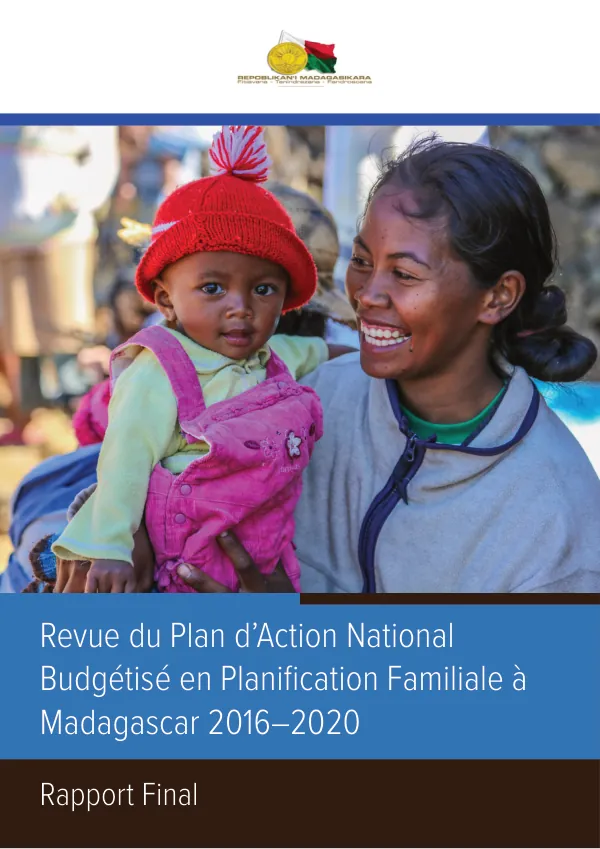
Revue du Plan d’Action National Budgétisé en Planification Familiale à Madagascar 2016–2020 : Rapport Final
Sign inHEALTH POLICY PLUS
Revue du Plan d’Action National Budgétisé en Planification Familiale à Madagascar 2016–2020 : Rapport Final
The Plan d'Action National Budgétisé en Planification Familiale à Madagascar 2016–2020 is a national action plan for family planning in Madagascar, developed with the support of the United States Agency for International Development (USAID) under the cooperative agreement No.
2021 · 72 pages
Sign in to readA free account is required to download.
Abstract
AID-OAA-A-15-00051. The plan aims to improve access to family planning services and increase the use of modern contraceptive methods among the population. The plan is based on six strategic axes: policy and environment favorable to family planning, creation of demand, offers and access to services, security of products, financing, and supervision, coordination, and evaluation of family planning. The plan also includes a budget allocation for each axis, totaling 1.5 billion Malagasy Ariary (approximately $450,000 USD) for the 2016-2020 period. The plan's objectives are to increase the use of modern contraceptive methods among women of reproductive age, reduce the total fertility rate, and improve the health and well-being of women and children. The plan also aims to strengthen the capacity of the Ministry of Health and other stakeholders to provide family planning services and to promote a culture of family planning among the population. The plan's methodology is based on a participatory approach, involving stakeholders from the government, civil society, and the private sector. The plan also includes a monitoring and evaluation framework to track progress and identify areas for improvement. The plan's analysis is based on the OECD's criteria for evaluation, which include effectiveness, relevance, coherence, efficiency, and impact. The plan's effectiveness is measured by the increase in the use of modern contraceptive methods, the reduction in the total fertility rate, and the improvement in the health and well-being of women and children. The plan's relevance is measured by the alignment of the plan's objectives with the country's development priorities and the needs of the population. The plan's coherence is measured by the consistency of the plan's objectives and strategies with the country's policies and laws. The plan's efficiency is measured by the cost-effectiveness of the plan's interventions and the use of resources. The plan's impact is measured by the improvement in the health and well-being of women and children and the reduction in poverty and inequality. The plan's recommendations include the need to strengthen the capacity of the Ministry of Health and other stakeholders to provide family planning services, to promote a culture of family planning among the population, and to increase the use of modern contraceptive methods among women of reproductive age. The plan also recommends the need to improve the availability and accessibility of family planning services, to increase the use of long-term contraceptive methods, and to promote the use of family planning services among marginalized groups. The plan's implementation is expected to be carried out by the Ministry of Health, in collaboration with other stakeholders, including civil society organizations, the private sector, and international partners. The plan's monitoring and evaluation framework will be used to track progress and identify areas for improvement. The plan's budget allocation is expected to be used to support the implementation of the plan's objectives and strategies, including the strengthening of the capacity of the Ministry of Health and other stakeholders to provide family planning services, the promotion of a culture of family planning among the population, and the increase in the use of modern contraceptive methods among women of reproductive age. The plan's geographic focus is on the entire country, with a particular emphasis on rural areas and marginalized communities. The plan's timeframes are 2016-2020, with a focus on the short-term (2016-2018) and medium-term (2019-2020) objectives and strategies. The plan's recommendations are expected to contribute to the achievement of the country's development priorities, including the reduction of poverty and inequality, the improvement of the health and well-being of women and children, and the promotion of a culture of family planning among the population.
Related documents
Documents in this collection
 2016
2016USAID DEC
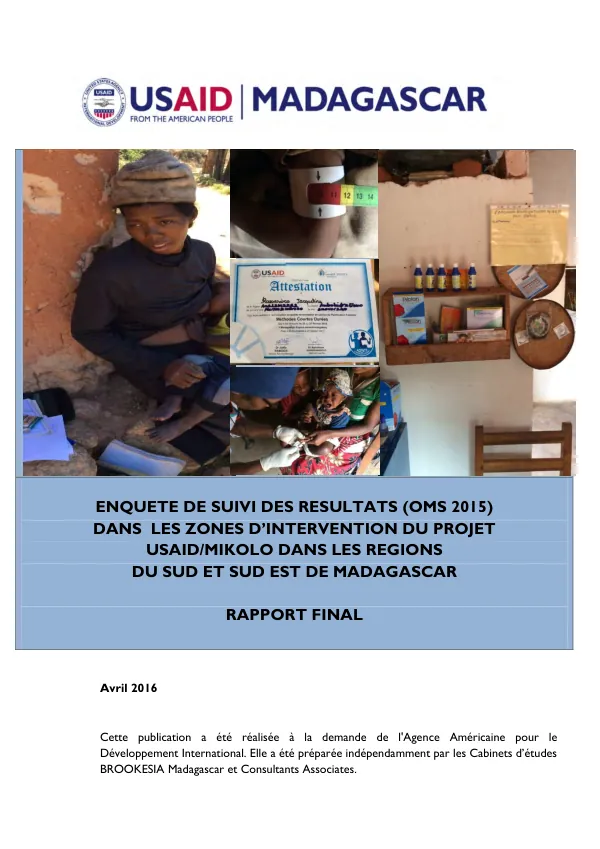
2015 Outcome Monitoring Survey (OMS) dans les zones d’intervention du projet USAID/MIKOLO dans les régions du Sud et Sud-Est de Madagascar
Open record 2018
2018USAID DEC