USAID DEC
Plan Regional de Fortalecimiento de Capacidades Técnicas para la Implementación de un Sistema de Monitoreo de Bosques para REDD+ en San Martín
Sign inAMAZON CONSERVATION TEAM
Plan Regional de Fortalecimiento de Capacidades Técnicas para la Implementación de un Sistema de Monitoreo de Bosques para REDD+ en San Martín
The Regional Plan for Strengthening Technical Capacities for the Implementation of a Forest Monitoring System for REDD+ in San Martín began with a diagnosis of technical capacities and the current situation of equipment, software, and infrastructure for the implementation of the forest monitoring system for REDD+ of the Regional Environmental Authority (ARA) and executing units of the Regional Government of San Martín.
2013 · 35 pages
Sign in to readA free account is required to download.
Abstract
This diagnosis was conducted in December 2013, with the support of the United States Agency for International Development (USAID) and The Nature Conservancy (TNC). The diagnosis aimed to determine the general situation of forest monitoring development in the San Martín Region, the technicians, their training, their experiences, their functions, and the articulation of these within the executing unit. The results showed the current situation of technical capacities, highlighting training in historical analysis of deforestation with different methodologies, but lacking a clear understanding of the entire process involved in monitoring and the forest monitoring system. The infrastructure also needs to be adapted to these purposes, as well as the assignment of computer equipment and programs for forest monitoring at the regional level. Among the main strengths of the professional specialists or technicians, a great commitment and interest in working in a monitoring system that helps control deforestation in the San Martín Region were shown. However, one of the main problems for this group of professionals is that they perform various activities, as well as the unstable labor situation. The diagnosis serves as a baseline for the implementation of actions at the level of coordination, activities, and requirements for the implementation of a Forest Monitoring System for REDD+ in the San Martín Region. The Regional Government of San Martín recognizes the need to develop strategies, policies, plans, etc., and has acknowledged the Mesa REDD+ since 2009, which is a space for dialogue where actions for adaptation and mitigation of climate change are promoted, articulated with national and international policies, led by the Regional Environmental Authority (ARA) and two teams. The San Martín Region has a significant forest area, approximately 60% of the national Amazonian surface, with a total area of 51,253 km². The region has a high impact of deforestation, based on different studies, such as the "Analysis of Forest Cover Changes in the San Martín Region," conducted by the LTA-UNALM-Mesa REDD+ of San Martín and supported by Conservation International. This analysis is part of the elaboration of the Regional Deforestation Baseline, carried out by the Regional Government of San Martín through the Regional Environmental Authority (ARA), which shows a significant non-forest area (including deforestation and/or natural change zones). The deforestation of San Martín began in the 1940s, with approximately 8,000 hectares per year, and increased significantly in the 1960s and 1970s, decreasing afterwards. The national colonization policy of the Amazon was a key factor in this phenomenon. The national framework for forest monitoring has a robust legal basis, including the National Environmental Policy, which indicates the need for mitigation, conservation, and sustainable use measures, as well as the National Action Plan for the Environment (PLANAA 2011-2021), which highlights the importance of forests and climate change. The Regional Government of San Martín has recognized the need to develop strategies, policies, plans, etc., and has acknowledged the Mesa REDD+ since 2009, which is a space for dialogue where actions for adaptation and mitigation of climate change are promoted, articulated with national and international policies, led by the Regional Environmental Authority (ARA) and two teams.
Related documents
Documents in this collection
 2013
2013USAID DEC
Plan Regional de Fortalecimiento de Capacidades en Cambio Climático y REDD+ para la Región San Martín
Open record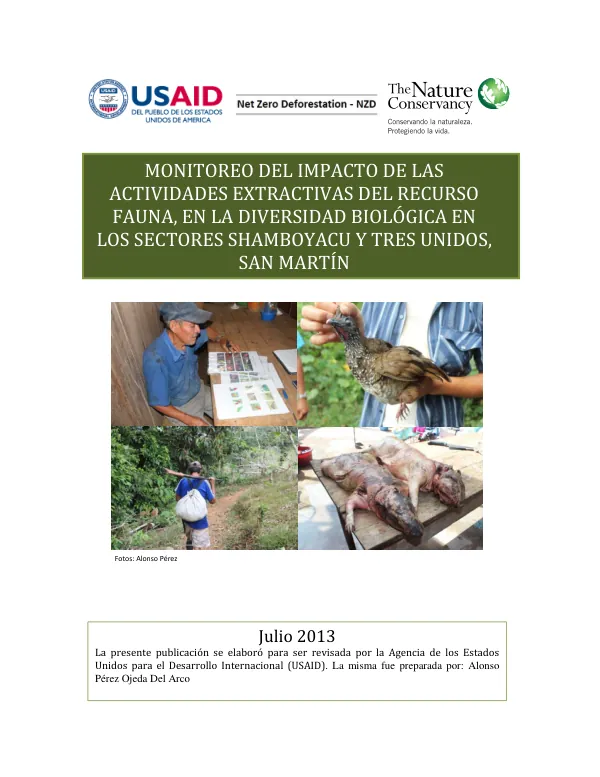 2013
2013USAID DEC
Monitoreo del Impacto de las Actividades Extractivas del Recurso Fauna, en la Diversidad Biológica en los Sectores Shamboyacu y Tres Unidos, San Martín
Open record