USAID DEC
Policy analysis and implementation COHEP (the Honduran Council for Private Enterprise)
Sign inUSAID. MISSION TO HONDURAS
Policy analysis and implementation COHEP (the Honduran Council for Private Enterprise)
The mid-term evaluation report has proven to be an immensely valuable document, especially for the new Honduran Council for Private Enterprise"s (COHEP) technical staff.
1991
Sign in to readA free account is required to download.
Abstract
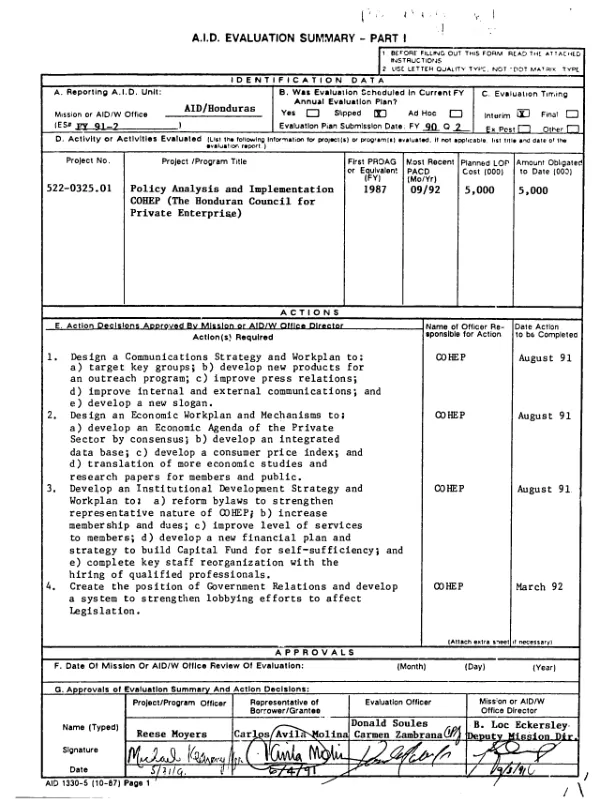
The report provides a good understanding of the current situation and nature of the project and suggests carefully considered actions and recommendations necessary to guarantee full achievement of project goals, purpose, and outputs. Overall, the report addressed the most important and relevant issues of the project in a very professional and objective manner. During the life of the project, COHEP"s Board of Directors has changed three times due to yearly elections according to its statutes. Also, COHEP has had three Executive Directors during the same time frame, who have moved on to key positions in the government. This situation has made it difficult for COHEP"s leadership and management to focus and fully understand, in detail and in depth, the Cooperative Agreement (CA) and its different components and covenants. Due to this and other reasons, COHEP has experienced delays in implementing a workable financial self-sufficiency strategy and workplan. In light of this situation, COHEP agreed to review and develop with A.I.D. and expatriate TA a new plan and strategy for achieving financial self-sufficiency. As part of this plan, COHEP has agreed to raise a minimum of L500,000 by 9/30/91. This new plan and strategy for financial self-sufficiency will permit A.I.D. and COHEP to determine the feasibility of reaching this goal. Therefore, funds that could still be available by the end of the original PACD are expected to be used for an extension of the project in order to successfully continue implementing the different project activities, while at the same time reaching financial self-sufficiency. The CA calls for reform of bylaws, as necessary. As a result of the mid-term evaluation, COHEP has contracted expatriate technical assistance in order to help it determine, through various mechanisms, why and how its bylaws should be revised. To date, COHEP has increased its membership base from 32 to 38 members. COHEP feels it is reaching its optimum size in order to perform and carry out its mandate efficiently. The CA specifies a given number of members to be reached to increase membership dues, which is being considered as part of the new financial self-sufficiency strategy. (Author abstract) For results of the evaluation, see the abstract of PD-ABC-194.