USAID. MISSION TO HONDURAS
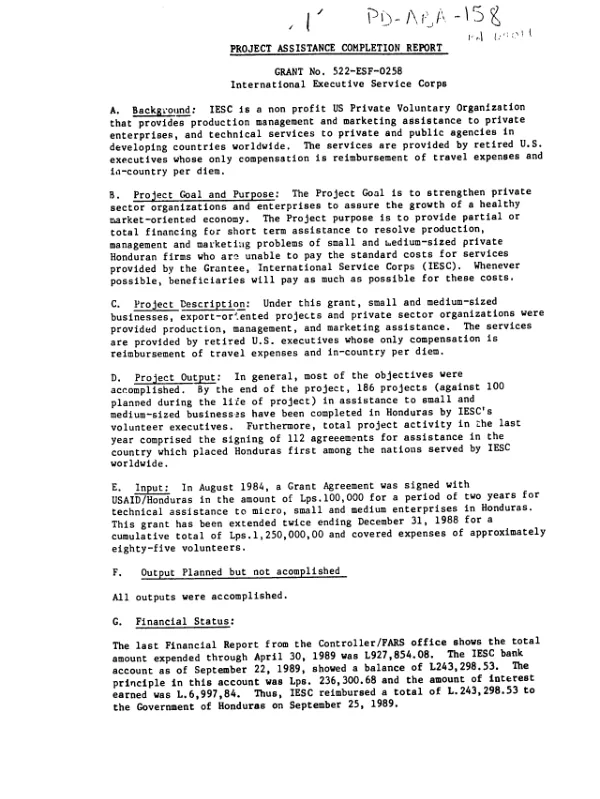
International Executive Services Corps
Summarizes final evaluation (PD-AAZ-188) of a project to foster and strengthen private enterprise in Honduras.
1989
Sign in to readA free account is required to download.
Abstract
The project is being implemented by the International Executive Service Corps (IESC) in Honduras. This evaluation reviews: (1) the performance of IESC"s activities in Honduras since 1983; (2) the guidelines used to charge clients for an IESC service; (3) the sectors and the size of companies that have been assisted by the IESC; (4) the impact of the Tegucigalpa office on the IESC program; and (5) whether to open an IESC office in La Ceiba. The methodology that was used to evaluate the above areas consisted of targeted interviews with recipients of IESC technical assistance, review of documents, and interviews with project personnel, as well as individuals in La Ceiba. The key findings and conclusions from this evaluation show that IESC clients have been extremely positive on the TA provided to them with the vast majority wanting a repeat visit from the IESC volunteer who had assisted them. With regard to how clients are charged, those who can afford to pay the full cost of IESC assistance do so and those who cannot pay based on what the IESC staff in-country feel that the client can afford. The evaluation recommends that minimum fees be established under the program financed with A.I.D. funds and a minimum tenure of one month be enforced for an IESC volunteer. The evaluation found that IESC assistance had been given to a wide range of clients both in terms of industry and in size. The size of projects reviewed ranged from a garmentmaker who employed three people to a sector study of 556 total employees in 12 companies. Wide industry diversification has been the rule. Additionally, the Tegucigalpa office was found to be well worth the investment and contributed 33 of the total 62 projects that were performed in Honduras during 1988. Finally, sufficient demand was found for IESC technical assistance in the La Ceiba area to warrant establishing an office in this city. Two lessons were learned. (1) Having an IESC office close to where a Volunteer Executive (VE) will be working is important so that support services can be maximized. In this way, the VE"s productivity increases. (2) A public relations program including direct advertising is needed to make as wide a variety of potential clients knowledgeable of what IESC has to offer, and to disseminate what IESC has to offer to the various productive sectors of the ccuntry. (Author abstract)