USAID. MISSION TO PERU
Policy analysis, planning and implementation
Project to strengthen the capacity of Peru"s public and private sectors to develop sound economic policies and programs.
1990
Sign in to readA free account is required to download.
Abstract
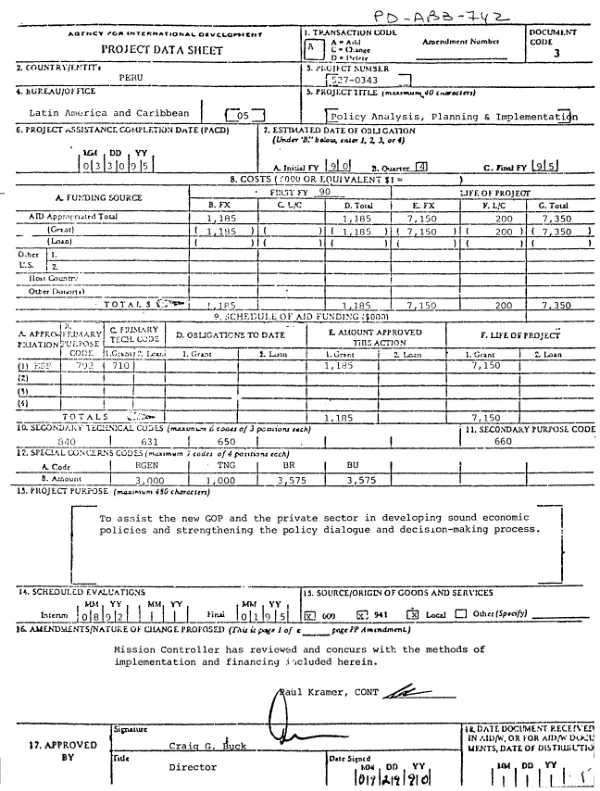
The project, to be implemented in the public sector by the Interministerial Committee for Economic and Financial Affairs (CIAEF) and the Secretary of the Presidency (SEP) and in the private sector by the Confederacion Nacional de Instituciones Empresariales Privadas (CONFIEP), will sponsor studies and TA on key economic issues and fund related training. Technical studies will focus on providing practical solutions to urgent economic policy constraints. These are likely to include: (1) economic stabilization and food aid targeting; (2) pricing policies; (3) tax reform and control of the fiscal deficit; (4) monetary policy and trade liberalization; (5) a wide range of institutional reform issues; and (6) multinational donor assistance, debt renegotiation, and access to world markets. Sector-specific studies will also be conducted. Policy-related subjects likely to be of interest in the agricultural sector include agricultural and marketing pricing, agricultural credit, land tenure, infrastructure, and TA for producers. Special attention will be given to the extent and environmental impact of coca growing and processing. CONFIEP will maintain a technical information library/data base of project studies. The training and information dissemination component will be directed at Government of Peru (GOP) officials, business and labor leaders, and parliamentary staffs directly involved in economic policy activities. Three types of training will be provided: (1) in-country training (seminars, workshops, and conferences) conducted by faculty from postgraduate institutions and other Peruvian experts; (2) short-term U.S. or third-country training for a limited number of GOP participants; and (3) long-term scholarships for five GOP personnel. Grant amendment of 3/27/95 extends PACD 2 years to 3/30/97 and introduces the following changes: (1) the TA team will place greater focus on administrative than on technical duties; (2) TA, training, and technical studies will address policy concerns in administrative simplification and decentralization, legal and regulatory reform, microenterprise and rural household development, agriculture, health and environmental protection, financial management and budget allocations of social ministries, and consolidation of economic reforms initiated in 1990; (3) the lead public sector implementing agency will be the Secretary General of the Presidency of the Republic (SGPR). CONFIEP will continue to lead implementation in the private sector. (PD-ABK-912)
Related documents