USAID DEC
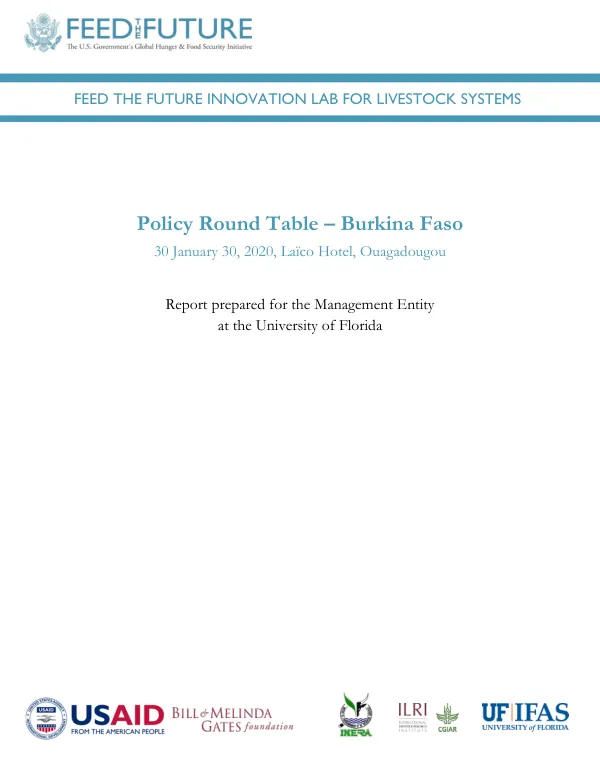
Policy Round Table – Burkina Faso: Report on the Feed the Future Innovation Lab for Livestock Systems
Sign inFLORIDA INTERNATIONAL UNIVERSITY
Policy Round Table – Burkina Faso: Report on the Feed the Future Innovation Lab for Livestock Systems
The Feed the Future Innovation Laboratory for Livestock Systems (Lab) has undertaken workshops on livestock policies in collaboration with national partners in focal countries.
2020 · 11 pages
Sign in to readA free account is required to download.
Abstract
These Round Tables aim to bring together livestock stakeholders to reflect on how best to implement policies that ensure the sustainability and productivity of the livestock sector, increasing incomes and improving nutrition of vulnerable households. In Burkina Faso, the Lab has implemented several research for development projects, led by multi-institutional teams reporting to institutions such as the Institute of Environment and Agricultural Research (INERA) and the International Livestock Research Institute (ILRI). One of the projects, the "One Child, One Egg per day" or "Un Oeuf" project, was carried out from July 2018 to July 2019 by a team of researchers from INERA and the University of Florida. The project results have shown that the gifting of chickens to children by community leaders, coupled with poultry production training and awareness creation among children's mothers about the importance of eggs in diets, leads to a significant increase in egg consumption in infants and thus improves their nutritional status. Although this project was implemented in Sanmatenga province in the North Central region of the country, the positive and significant results achieved have generated a great deal of interest in how the intervention and approach could be extended to other regions of the country. A workshop was organized to discuss options for the expansion to other regions of the One Child, One Egg project. The workshop took place on January 30, 2020, at the Laïco Hotel and was organized in collaboration with INERA and with the active support of the country coordinator of the Lab, Dr. Isidore B. Gnanda, also from INERA. The workshop aimed to identify the key components and lessons learned from the "One Child, One Egg per Day" project, as well as identifying the actors and how the project will be extended, adapted or scaled up. The workshop had five sessions: the opening ceremony, introductory presentation on the objectives, presentation of the "One Child, One Egg per day" project, followed by discussion, group work on identifying the key components and lessons learned from the project, and recommendations and ideas for the next steps. The report summarizes the sessions, the main discussion points, and the main achievements. The workshop was attended by 25 adult participants, including representatives of ministries, research institutions, universities, development partners, NGOs, producer associations, and private sector actors. The opening ceremony of the Round Table was presided over by Dr. Hadja O. Sanon, Deputy Director of INERA, representing the Director of INERA. She was joined by Dr. Renata Serra, representing the Lab's Management Entity, and Mr. Pindé Souleymane, representing the Director of Staff of the Ministry of Animal and Fisheries Resources. The opening ceremony included two speeches: by Dr. Renata Serra and Dr. Hadja O. Sanon. Dr. Renata Serra welcomed the participants on behalf of the Lab's ME and thanked all participants for their attendance and for their continued support of the Lab's activities. Dr. Hadja O. Sanon, who delivered the keynote address, welcomed the participants and recalled the vision of the Lab and the role of the UF and ILRI within the research consortium. She told participants that the goal of the Round Table was to discuss opportunities to expand the successful experience of the "One Child, One Egg Per Day" project. She hopes that the results of the discussions would inform a timeline to disseminate project results and identify suitable institutional arrangements, actors, actions, and resources to be allocated in the next 12 months. During the session on the goals of the Round Table, Dr. Renata Serra outlined the main motivations for holding the Round Table. She recalled the fact that in livestock systems, as in many other social and economic systems, there is a separation and a lack of communication between the world of decision-makers and the world of researchers, and both of these are often separated from the realities in which communities live. Because of this, there is an urgent need to create opportunities for a balanced dialogue between policy makers, researchers/experts, and community members. The Round Table is such an opportunity, allowing for wide sharing of research results to enhance knowledge and encourage evidence-based decision-making that better incorporates the well-being of local communities. The specific objectives of this workshop were to exchange and reflect on the elements of success of the One Child, One Egg Per Day project and to identify options for scaling, and to think about how to use the lessons of the project to achieve better results in other contexts beyond Sanmatenga province. The workshop aimed to identify the best ways of implementing interventions that will ensure better ownership and scaling of the results generated by the "One Child, One Egg Per Day" project.