ABT. GLOBAL
Semi-annual Report, October 1, 2019 – March 31, 2020
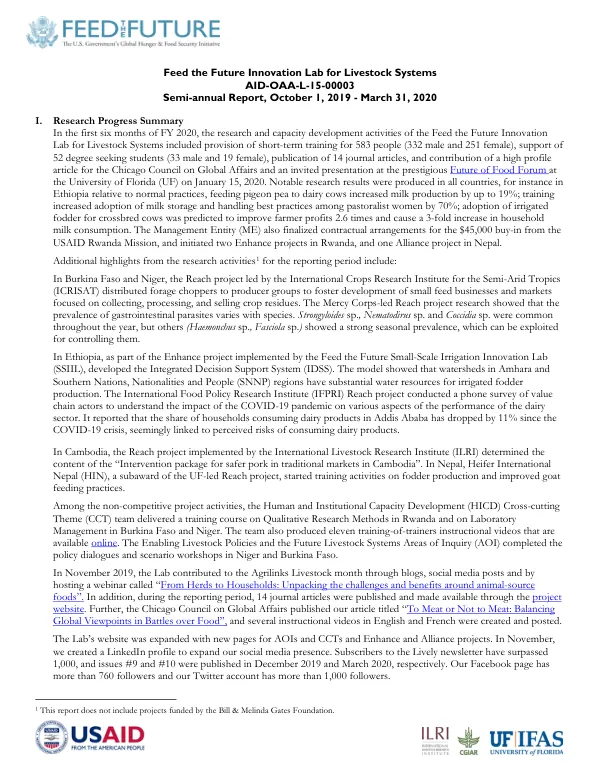
The Feed the Future Innovation Lab for Livestock Systems, a research and capacity development initiative, was established in 2018 with funding from USAID's Food Security Program.
2020 · 20 pages
Sign in to readA free account is required to download.
Abstract
The lab's primary focus is on enhancing the productivity and profitability of the animal-source food (ASF) value chain in developing countries. Research and capacity development activities were conducted in six countries, including Ethiopia, Burkina Faso, Niger, Rwanda, Cambodia, and Nepal. In Ethiopia, research results showed that feeding dairy cows up to 18% of their diet with pigeon pea increased milk production by up to 18%. Training on milk storage and handling practices among pastoralist women increased adoption by 70%. In Rwanda, the adoption of irrigated fodder for crossbred cows was predicted to improve farmer profits by 2.6 times and increase household milk consumption by three times. The lab's Enhance project in Rwanda initiated two projects, and the Alliance project in Nepal launched one project. In Burkina Faso and Niger, the Reach project led by ICRISAT distributed forage choppers to producers to foster the development of small-scale feed businesses and markets. The project also showed that the prevalence of gastrointestinal parasites varies with species, with Strongyloides, Nematodirus, and Coccidia being common throughout the year. In Ethiopia, the Enhance project implemented by SSIIL developed the Integrated Decision Support System (IDSS). The model showed that watersheds in the Amhara and SNNP regions have substantial water resources for irrigated fodder production. The IDSS also predicted that the adoption of irrigated fodder for crossbred cows would improve farmer profits by 2.6 times and increase household milk consumption by three times. The Reach project in Cambodia determined the content of the "Intervention package for safer pork in traditional markets in Cambodia." In Nepal, Heifer International Nepal, a subaward of the UF-led Reach project, conducted training activities on fodder production and improved goat feeding practices. The Human and Institutional Capacity Development (HICD) Cross-cutting Theme (CCT) delivered a training course on Qualitative Research Methods in Rwanda and on Laboratory Management in Burkina Faso and Niger. The team also produced 11 instructional videos on instructional videos are available online. The Enabling Livestock and the Future Livestock Systems Areas of Inquiry (AmI) completed the research dialogues and scenario workshops in Niger and Burkina Faso. The lab contributed to the Agrilinks Livestock month through blogs, social media posts, and a webinar called "From Herds to Households: Unpacking the challenges and benefits around animal-source foods." The lab's website was expanded with new pages for AOIs and CCTs, Enhance, and Alliance projects. A LinkedIn profile was created to expand social media presence, and the Lively newsletter surpassed 1,000 subscribers. The Livestock Systems Innovation Lab implements four types of competitively awarded projects. Reach projects last up to four years, with a budget of up to USD 1.25 million, and focus on one or more Areas of Inquiry (AOIs). Focus projects are proof of concept studies or research for development, originally designed to take up to a year with budgets of up to USD 130,000 and focus on just one AOI. Enhance projects complement the existing portfolio with new research that extends the scope and impacts of existing projects, whereas Alliance projects build capacity and strengthen research and development research in developing countries. In Ethiopia, the Reach project led by Smith, UC-Davis, aimed to address young stock mortality in smallholder farms and pastoral herds. The project trained 150 farmers in the three Minimum Disturbance Packages of the Young Stock Mortality Consortium. The project was delayed due to the COVID-19 pandemic, but preliminary analyses revealed that Cryptosporidium parvum and enterotoxigenic Escherichia coli ETEC/K100 are the primary causes of diarrhea in pastoral and peri-urban production systems. The project found high rates of failure of passive transfer of immunity in both production systems. Improved management practices, including housing and neonatal care, can improve the situation. The USAID-funded PRIME II project is interested in incorporating the recommendations into their activities. The project was granted a no-cost extension until September 30, 2020. In Ethiopia, the Reach project led by Vipham and Pendlers, KSU, aimed to link cattle nutrition to human nutrition. The project conducted on-station variety identification and production studies at Melkassa, which were completed. The research station organized field days for 159 farmers, 29 development agents, and extension experts, as well as 16 researchers and decision-making officers. EIAR distributed 600 brochures with project results and planting recommendations. The agronomic and feeding studies at Hallsa University were completed in the first quarter. Preliminary results indicate that replacing 10% of the typically used concentrate mix with pigeon pea leaves increased milk yield and 4% fat-corrected milk yield by