USAID DEC
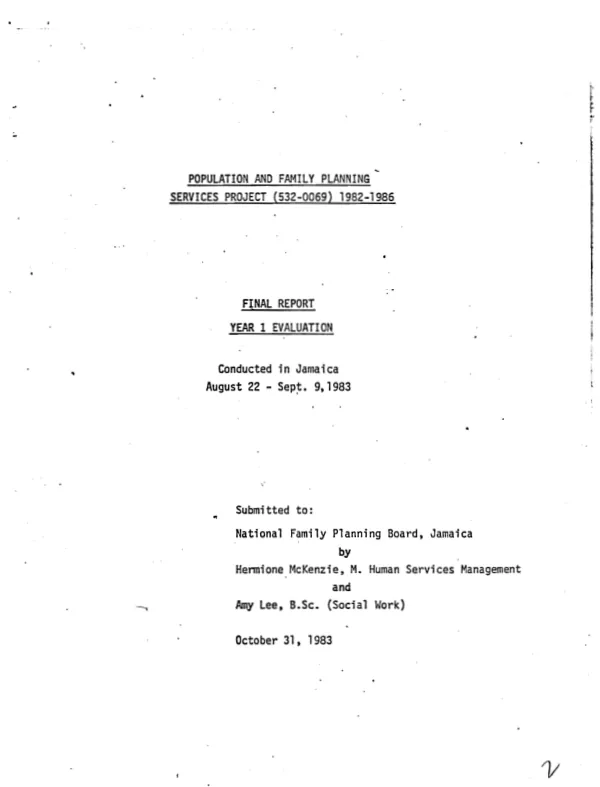
Population and family planning services project (532-0069) 1982-1986 : final report, year 1 evaluation
Sign inUSAID. MISSION TO JAMAICA
Population and family planning services project (532-0069) 1982-1986 : final report, year 1 evaluation
Evaluates project to expand and improve delivery of family planning (FP) services in Jamaica.
McKenzie, Hermione; Lee, Amy · 1983
Sign in to readA free account is required to download.
Abstract
Special evaluation covers the period 3/82-8/83 and is based on document review, site visits, and interviews with USAID/J, Government of Jamaica (GOJ), National Family Planning Board (NFPB), and other project staff. Despite a 6-month implementation delay, the project has achieved some success. Already 352 of a planned 370 Ministry of Health (MOH) clinics are offering FP services (although 53% are staffed by only a midwife and community health worker and have limited facilities) and sterilizations have increased 26%. With 1,830 new retail outlets, commercial contraceptive sales have increased 34% (vs. a targeted 25% by 1985) and a market survey is planned. An inter-agency population policy coordinating committee has been established and the National Population Policy has been prepared and presented to the GOJ parliament. Research into determinants of fertility, migration, and contraceptive prevalence is underway at the University of the West Indies (UWI) Department of Sociology and the National Planning Agency (the latter has acquired an additional staff member, a vehicle, and equipment). The population diploma course at UWI is set to begin in 10/83. Although 2 NFPB personnel have begun overseas training (4 are set to go after 4/83) and some in-country courses have been held (i.e., a 3-day management seminar for NFPB and other project staff; 4 NFPB inservice programs for 84; a seminar for 14 private doctors; and a male motivation seminar for 42), the MOH training plan has not yet been approved and no MOH staff have yet received AID-funded primary health care training (vs. a planned 2,000). The crude birth rate has not decreased and contraceptive acceptors have increased overall by only 3%. Nonclinical outreach is set to begin soon, however it is unlikely that the targeted 50% increase in acceptors can be achieved. The project has also been hampered by: delayed arrival of contraceptive supplies (other supplies including 8 of 10 vehicles arrived on time) and inadequate communication about supply shortages; failure to fill all NFPB staff positions; and GOJ economic difficulties. Recommendations are included.
![Midterm evaluation of the PROFAMILIA [Asociacion Pro-Bienestar de la Familia Nicaraguense] diversification, sustainability, and social marketing grant](https://covers.devme.ai/gen/5467.webp)