USAID. MISSION TO EL SALVADOR
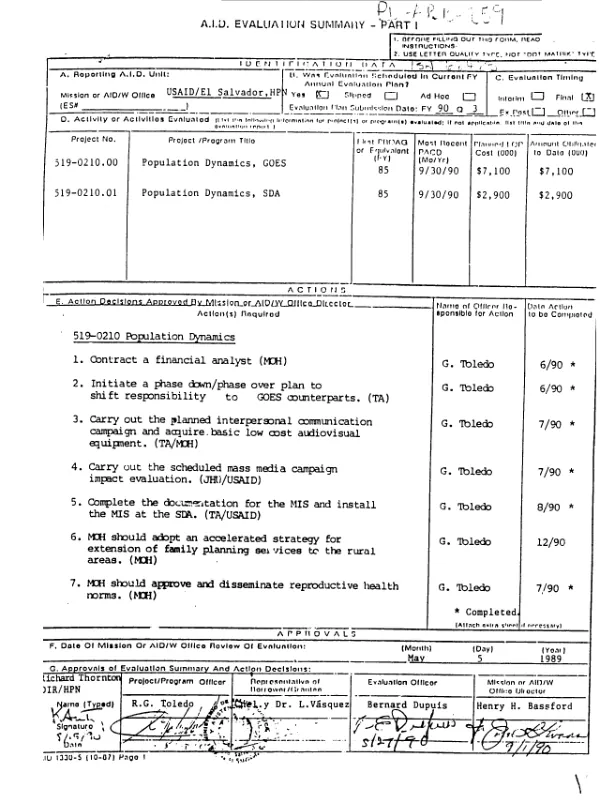
Population dynamics, GOES -- population dynamics, SDA
Summarizes final evaluation (PD-ABA-289) of a project to strengthen family planning (FP) services in El Salvador by providing assistance in administration, training, IEC, management information systems, and policy reform to involved governmental institutions.
1990
Sign in to readA free account is required to download.
Abstract
The evaluation covered the period FY85-10/89. The project operated under extraordinarily difficult conditions, including an earthquake, civil conflict, economic decline, an exodus of personnel, and disruption by municipal and national elections. While the project overcame these obstacles to a certain extent and made substantial progress in each component, much more needs to be done to consolidate these advances. Effective forums were provided for coordination, planning, and monitoring activities, and annual plans outlined activities and budgets that were consistent with project objectives. Training activities were particularly successful, exceeding the target number of trainees by 20%. While training effectively targeted rural workers, more attention could have been given to health promoters, beginning doctors, and graduate nurses. The mass media campaign was also effective, reaching nearly 4 million persons; however, the companion interpersonal communication campaign was delayed. The computerized management information system developed by the project improved contraceptive distribution and warehousing and produces orderly and timely service delivery information that emphasizes couple-years of protection as a measure of progress. A national population policy was adopted, although progress in disseminating the policy lagged. Several lessons were learned. (1) Institution building projects should have at least a five-year timeframe. (2) Complicated bureaucratic structures should be avoided; if this is impossible, substantial administrative and financial management assistance are essential. (3) TA should be provided through close working relationships with identified counterparts. (4) FP must receive special attention if it is to be effectively integrated in a program involving multiple health activities. (5) Training provided to health workers must be matched by training for the officials who organize services and establish priorities. (6) Both an initial assessment of training needs and a periodic review of training outcomes are needed to maintain proper follow- up to training. (7) Both mass media and interpersonal communication activities are necessary for effective IEC campaigns. (8) A computerized logistics management system can be effective in improving contraceptive supply as well as in providing a service statistics system that can be operated by service delivery staff.
Related documents