USAID. MISSION TO GHANA
Population dynamics program
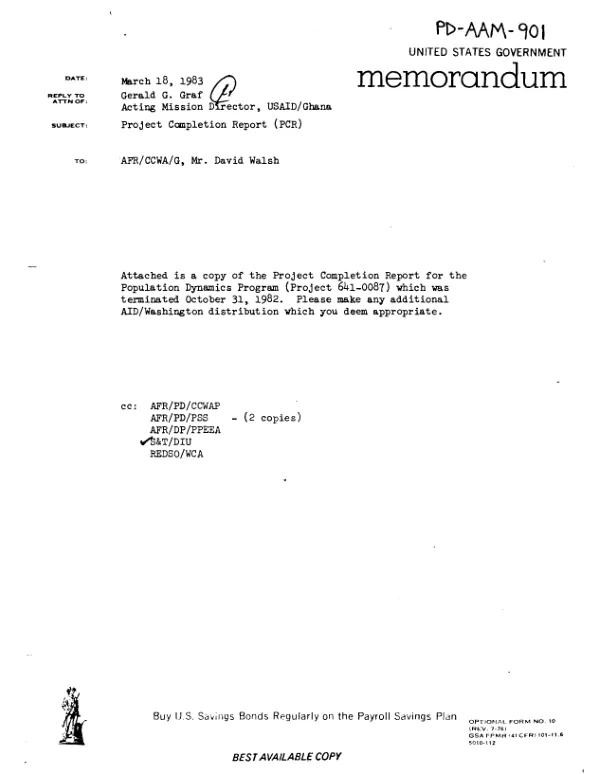
Provides final Mission report (9/77-10/82) on a project to upgrade the capability of the University of Ghana"s (UG) Population Dynamics Program (PDP) to promote population education, training, and research in Ghana and other African countries.
1983
Sign in to readA free account is required to download.
Abstract
Although extended beyond the original 6/79 termination date, the project, follow-on to a regionally funded project never subjected to hard scrutiny, reached few targets and the PDP"s reputation, enhancement of which was a key project objective, has been called into question. Only one of two planned international symposia took place (in Monrovia) - although two seminars were held at the UG - and only four of six planned demography research projects (costs of which rose due to inflation) were awarded (to the Universities of Benin, Togo, and Ife, Nigeria). Only one of eight targeted regional monographs was produced. Research efforts seem to be individual academic exercises of little public value; the Government of Ghana does not actively utilize PDP research findings. Due to poor economic conditions in Ghana, many of the eight (versus six targeted) participants receiving long-term U.S. demography training have been permitted to remain in the United States to pursue even higher degrees, despite vigorous USAID/G protests. It is doubtful whether the six still studying will return to Ghana, thus obviating the project objective of building up a trained UG faculty. In other areas, only four Ghanaians and three non-Ghanaians (of 15-20 targeted) received scholarships to the UG, and less than 10% of the funds to obtain services of the University of North Carolina was employed. A major problem was the lack of administrative expertise by the PDP Program Director, a self-styled academician who traveled throughout West Africa and Europe and left an inexperienced assistant in charge of a drifting program. Moreover, researchers (also academics) did not comply with A.I.D. voucher regulations, and no annual and few trip reports were submitted. The key remaining issue is the submission of final receipts and vouchers from the West African research subcontracts. The major lesson learned is that academics cannot be relied on to administer programs in accordance with A.I.D. regulations.
Related documents