USAID. MISSION TO EGYPT
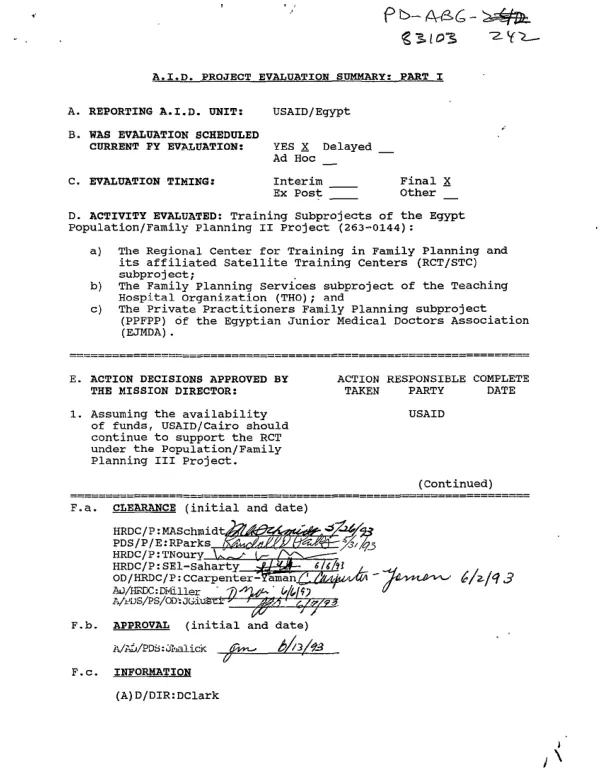
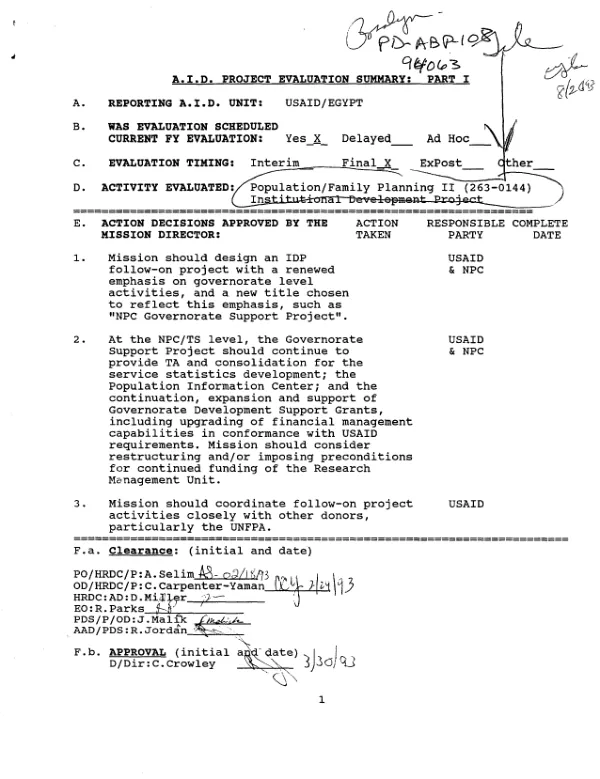
Population/family planning I and II
Summarizes attached evaluation (XD-AAU-507-A) of a project to increase family planning (FP) practice in Egypt.
1986
Sign in to readA free account is required to download.
Abstract
Evaluation covered the period through 5/86 and was based on site visits, document review, and interviews with over 80 Government of Egypt (GOE), private sector, TA, and USAID/E personnel. The project has been characterized by plurality. The diversity of activities supported has contributed to a diffusion of effort. Service delivery has not received sufficient emphasis. However, this situation is improving: several initial activities have recently terminated while core activities (i.e., service delivery, training, research) continue to be supported. Policy dialogue has been limited to a few top-level GOE leaders. Strategies to support policy development and awareness of population issues among health workers, opinion leaders, and decisionmakers are inadequate, and project activities in policy development and in information, education, and communication need redirection to provide more focused support for the GOE"s evolving needs. USAID/E support for private sector activities has increased over time and these activities have generally been highly successful. However, assistance has emphasized the nonprofit sector, which has limited, primarily urban, coverage. FP services are still not fully available in rural areas. A major lesson learned is that a "target of opportunity" approach, adopted in the absence of strong host country political commitment and institutional framework, is likely to result in diffusion of effort and program impact. Moreover, in the overall political and institutional context, assistance to the private sector has proven relatively more effective than efforts to energize the GOE"s FP program. The evaluation recommended that USAID/E: (1) adopt a more focused project approach, emphasizing service delivery and institutional development activities; (2) expand the role of the private sector, both its traditional nonprofit and market-oriented elements; (3) incorporate support for an augmented, Egyptian-designed and -implemented policy development program carefully targeted to broaden support in policymaking circles. USAID/E takes exception to some degree with the evaluation, stating that in particular the realities of the situation vis-a-vis institutional development and TA have not been adequately assessed. The lack of one, effective GOE agency responsible for implementation is a major constraint and TA can only have a limited impact in this context. Future assistance will focus on improving service delivery (to which institution building is but a means). Institutional assistance will be provided in response to demonstrated GOE commitment.