USAID. MISSION TO EGYPT
Population sector assessment
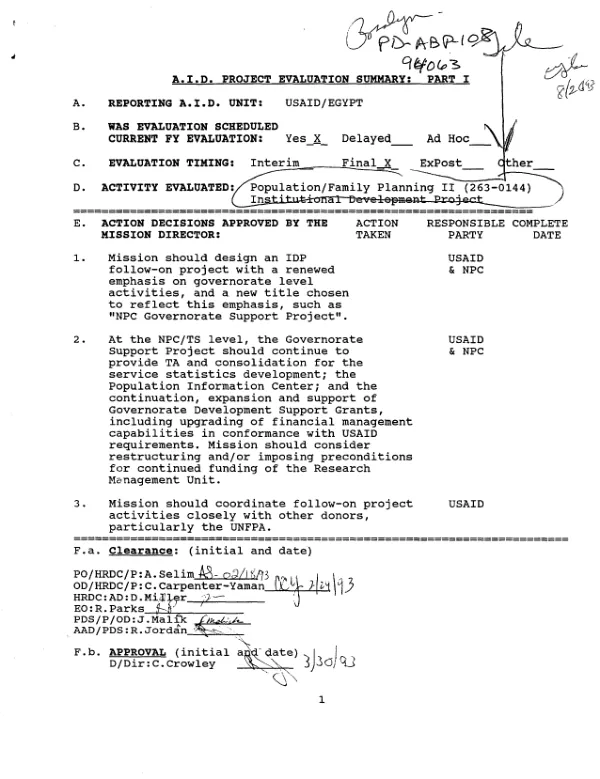
Summarizes evaluation (XD-ABD-550-A) of Egypt"s population problems and USAID/E"s Office of Population.
1989
Sign in to readA free account is required to download.
Abstract
The evaluation covered the period through 3/89. The Egyptian government aims to reduce the population growth rate from 2.8% to 2.1% by the year 2001. To achieve this goal, the contraceptive prevalence rate will have to increase from 37.6% to at least 51%. Although this will require tremendous effort, there have been some recent progress. Examples include the following. (1) Contraceptive prevalence has increased from 30% in 1984 to 38% in 1988. (2) There has been a dramatic, positive change in the political commitment to address population issues, with forceful calls to action at the highest level. (3) A National Population Council (NPC), which was established in 1985, has served as a focal point for population-related activities. The NPC has set specific, measurable goals for expanding contraceptive delivery and has begun to develop governorate action plans on population. (4) Family planning has gathered support from both Muslim and Coptic leaders. (5) Egyptian organizations, with A.I.D. assistance, have increased their support for family planning service delivery. (6) An effective partnership between the public and private sectors has evolved. (7) Service quality has greatly improved. (8) The State Information Program for family planning has greatly improved. (9) Egyptian medical researchers and institutions are carrying out some of the world"s best contraceptive research. USAID/E"s Office of Population is well positioned for an expanded Egyptian family planning program. Highlights of the Office"s past few years include: meeting objectives to increase access to family planning; improving relationships with key Egyptian institutions; assessing contraceptive prevalence and method mix; assisting in the improvement of family planning messages; and supporting biomedical research on contraceptive technology.
Related documents