USAID DEC
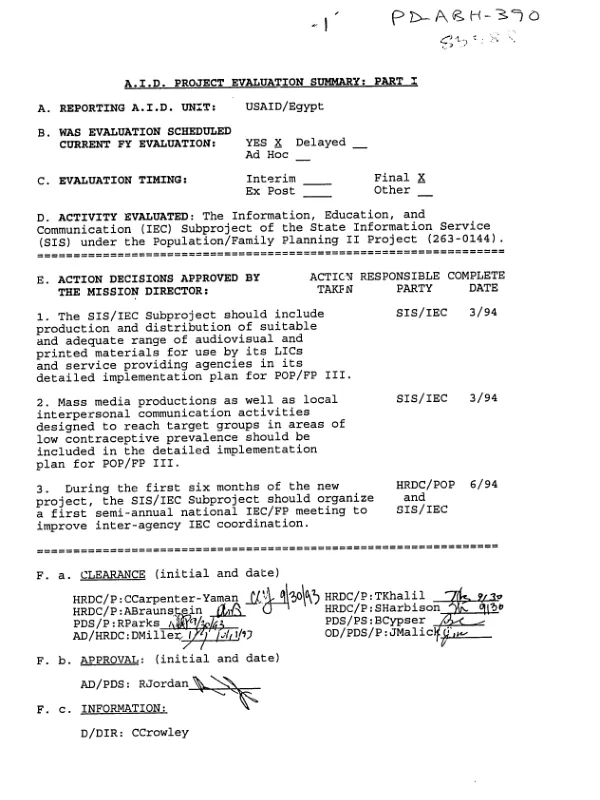
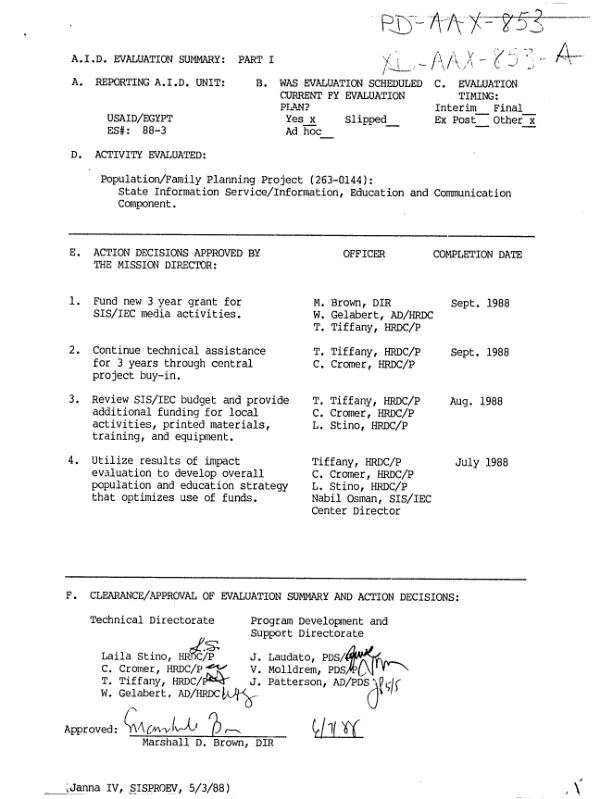
Population/family planning project (263-0144) : state information service/information, education and communication component
Sign inUSAID. MISSION TO EGYPT
Population/family planning project (263-0144) : state information service/information, education and communication component
Summarizes attached evaluation of Egypt"s State Information Service"s Information, Education, and Communication Center (SIS/IEC), created to promote family planning (FP) under the Population Projects (263-0029 and -0144).
1988
Sign in to readA free account is required to download.
Abstract
Special evaluation focuses on institutional development, is based on interviews with contractor and SIS/IEC personnel, document review, and site visits, and covers the period 1985-88. SIS/IEC has made good progess, particularly in selection of media themes, production of high-quality TV spots utilizing private contractors, and financial management. Specific findings are: SIS/IEC organization, management, and staff are competent, although staff too often are dependent on the Director for routine administrative decisions; management would benefit, however, from additonal professional staff and improved utilization of national consultants and training. Financial management has also been improved. Program development (especially TV advertising) has improved markedly with the use of private agencies for designing, producing, and testing the materials. The pretesting and professional design used for TV spots should now be systematically extended to SIS/IEC"s other products and activities. Local educational activities (e.g., governorate-level seminars, village-level public meetings, and meetings for specific audiences) have been surprisingly successful in attracting large, mixed audiences of men, women, and children and in providing detailed explanations of contraceptive methods as well as serious presentations of Islamic views on FP. According to the evaluation team, the presence of television video crews and the provision of small incentives during question and answer sessions contribute to the success of these programs. The TA contractor has been very effective in developing work plans, improving financial management, and subcontracting the development of media materials to private agencies. These advances have not yet coalesced into a comprehensive management strategy, however. Recommendations are to (1) reorganize SIS/IEC, add staff, and improve staff skills by increasing collaboration between national consultants and counterparts; (2) develop a comprehensive program development strategy using integrated media (TV, rural meetings, pamphlets, and films), including studies to identify target audiences and priority topics; and (3) continue the present TA approach and expand use of short term consultants. USAID/E comments that the evaluation report, although poorly written and organized, has been very effective in that SIS/IEC has already implemented almost all the recommendations.
Related documents