USAID DEC
Post-tsunami survey of the 28 September 2018 tsunami near Palu Bay in Central Sulawesi, Indonesia: Impacts and challenges to coastal communities
Sign inUNIVERSITAS SYIAH KUALA
Post-tsunami survey of the 28 September 2018 tsunami near Palu Bay in Central Sulawesi, Indonesia: Impacts and challenges to coastal communities
The 28 September 2018 tsunami near Palu Bay in Central Sulawesi, Indonesia, was triggered by a 7.5-Mw earthquake.
2019 · 1 pages
Sign in to readA free account is required to download.
Abstract
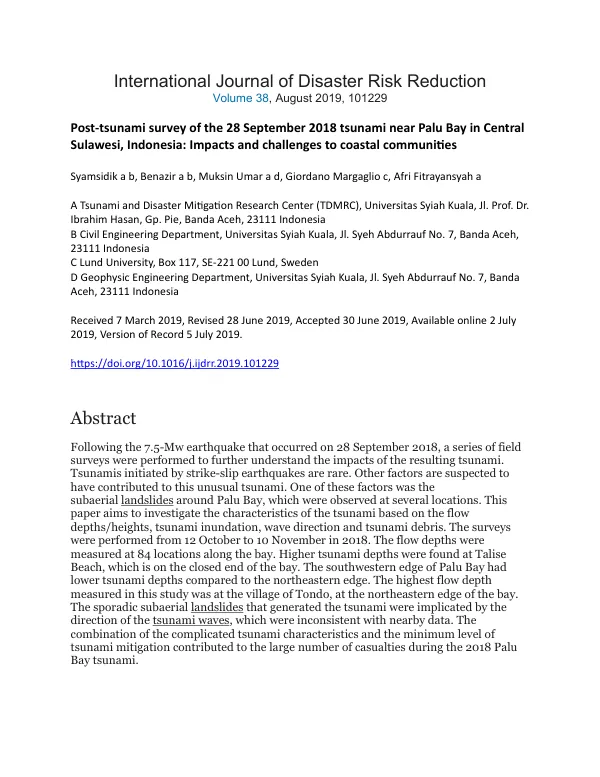
A series of field surveys were conducted from 12 October to 10 November 2018 to investigate the characteristics of the tsunami. The surveys aimed to understand the flow depths/heights, tsunami inundation, wave direction, and tsunami debris. Flow depths were measured at 84 locations along the bay, revealing higher tsunami depths at Talise Beach, which is located on the closed end of the bay. In contrast, the southwestern edge of Palu Bay had lower tsunami depths compared to the northeastern edge. The highest flow depth measured in this study was at the village of Tondo, situated at the northeastern edge of the bay. The flow depths varied significantly along the bay, with the highest values observed at the closed end. The direction of the tsunami waves was inconsistent with nearby data, suggesting that sporadic subaerial landslides may have contributed to the tsunami. The landslides were observed at several locations around Palu Bay. The combination of the complicated tsunami characteristics and the minimum level of tsunami mitigation measures in place contributed to the large number of casualties during the 2018 Palu Bay tsunami. The study highlights the importance of understanding the complex factors that contribute to tsunami events, particularly those triggered by strike-slip earthquakes. The Palu Bay tsunami was a rare event, with tsunamis initiated by strike-slip earthquakes being uncommon. The study's findings emphasize the need for more effective tsunami mitigation measures, particularly in areas prone to such events. The research also underscores the importance of conducting thorough field surveys to understand the characteristics of tsunami events and to inform strategies for reducing the risk of future disasters. The study's results can be used to improve tsunami warning systems and to develop more effective emergency response plans.
Related documents