USAID. BUR. FOR POLICY AND PROGRAM COORDINATION. CENTER FOR DEVELOPMENT INFORMATION AND EVALUATION (CDIE)
Postconflict elections, democratization and international assistance
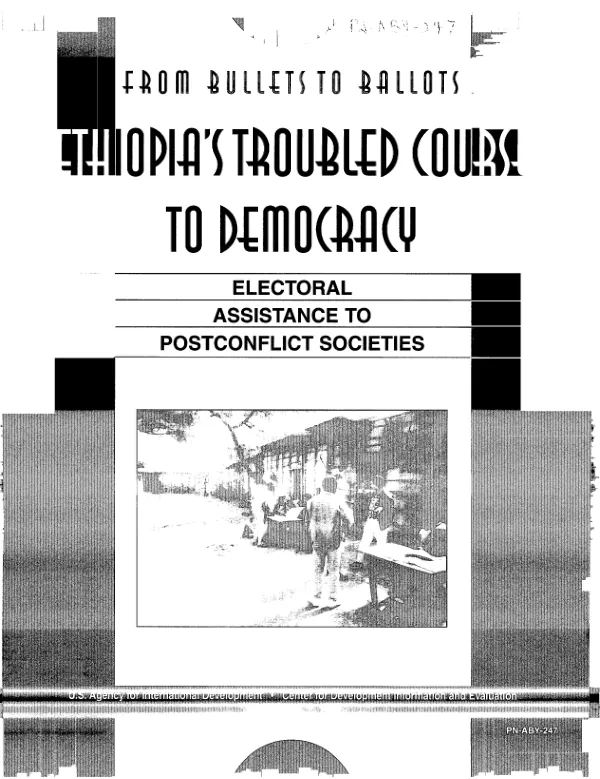
This volume focuses on a relatively new phenomenon in the democracy promotion activities of the international community: assistance to elections held in countries just emerging from violent internal conflict or even civil war.
Kumar, Krishna, ed. · 1970
Sign in to readA free account is required to download.
Abstract
The decision to hold elections is usually negotiated at the time of a peace accord out of a desire both to install a legitimate, democratic government and to consolidate fragile peace agreements under a democratic system. The bulk of the volume consists of case studies of post-conflict elections in eight countries that differ in regard to sociopolitical environment and region, the severity of the conflict, and the type of post-conflict election: El Salvador, Nicaragua, Haiti, Cambodia, Ethiopia, Angola, Mozambique, and Liberia. Except in the case of Haiti, the case studies are available separately (see PN-ABY-245-249, PN-ACA-900, and PN-ACA-903). The studies, which are authored by scholars who followed their evolution firsthand, explain the nature and context of post-conflict elections, outline the process through which they were planned and carried out, and analyze the role the international community played in the undertaking. The case studies also shed light on the effect of these elections on the promotion of democracy and consolidation of peace in the countries. The studies focus on three sets of questions. The first pertains to the elections themselves: What was the overall political and social context in which post-conflict elections took place? What were they supposed to achieve? How were the elections planned and conducted? What were the results of the elections? The second set of questions focuses on the consequences of the elections: How did elections promote or hinder the democratization and reconciliation processes in these countries? What factors and conditions affected the outcome? The final set of questions deals with the policy lessons for the international donor agencies. Includes bibliography. (Author abstract, modified)