ENERGY SYSTEMS INTERNATIONAL, INC.
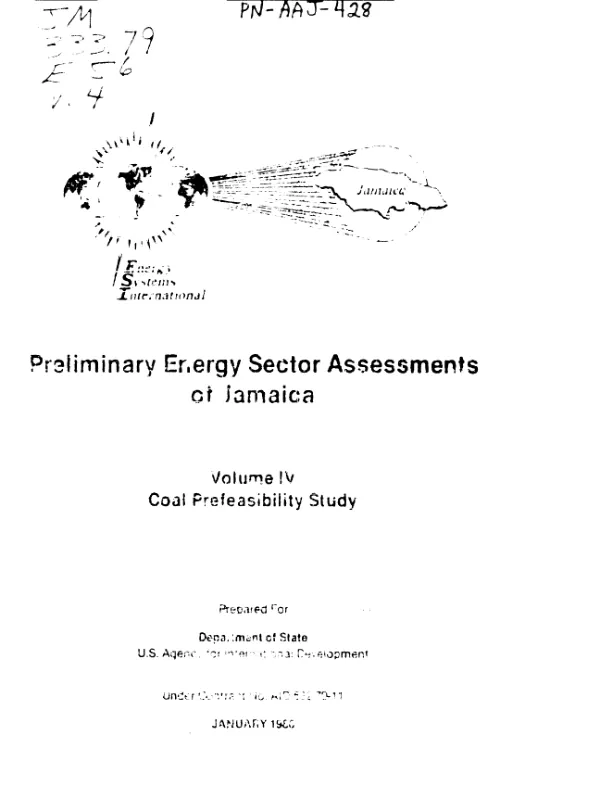
PRELIMINARY ENERGY SECTOR ASSESSMENTS OF JAMAICA, V. 4, COAL PREFEASIBILITY STUDY
Because dependence on costly imported fuel is hindering Jamaica"s economic growth, USAID/Jamaica and the Government of Jamaica (GOJ) sponsored a preliminary assessment to identify viable alternative energy options.
1970
Sign in to readA free account is required to download.
Abstract
Technological studies were published in three volumes (with volume three being in four parts, for a total of six volumes), to which two introductory volumes were added, providing, respectively, an executive summary of the entire assessment and an economic assessment of the individual areas. This study, the second technical volume, assesses the technical, economic, and environmental feasibility of diversification from oil to coal for generating electric power for the Jamaican Public Service Company (JPS) and the bauxite/alumina industry. The study found that the JPS system has sufficient capacity for current demand, but better maintenance, especially of the newer, more efficient units, is needed to avoid blackouts. Current JPS and alumina company boilers cannot be retrofitted to burn coal directly, but may be able to burn a coal/oil mixture or coal gasification product. Developments in these areas should be monitored. Evaluation of four alternative electricity generating schemes (coal-fired, combined-cycle gas turbine, low-speed diesel, and oil-fired) indicates that coal-fired units will provide economic benefits only if port and coal unloading facility costs are kept low or if the coal-oil cost differential widens rapidly. Old Harbour Station, Montego Bay, Port Esquivel, and Cuckold Point in New South Manchester are possible sites for a coal-fired plant. Negotiations should be begun for joint use of the harbor facilities and site at Port Esquivel and Cuckold Point. If these negotiations succeed, a more detailed cost and cost-benefit estimate should be prepared. Although coal supply and shipping conditions seem favorable, a study is recommended to confirm the delivered price of coal. While a preinvestment feasibility study is not recommended at this time, a full feasibility study is recommended in 2-3 years if all other factors prove positive. Appendices include a list of four references (1978), data on various energy programs/sectors, and a summary of a splinter group discussion.