USAID DEC
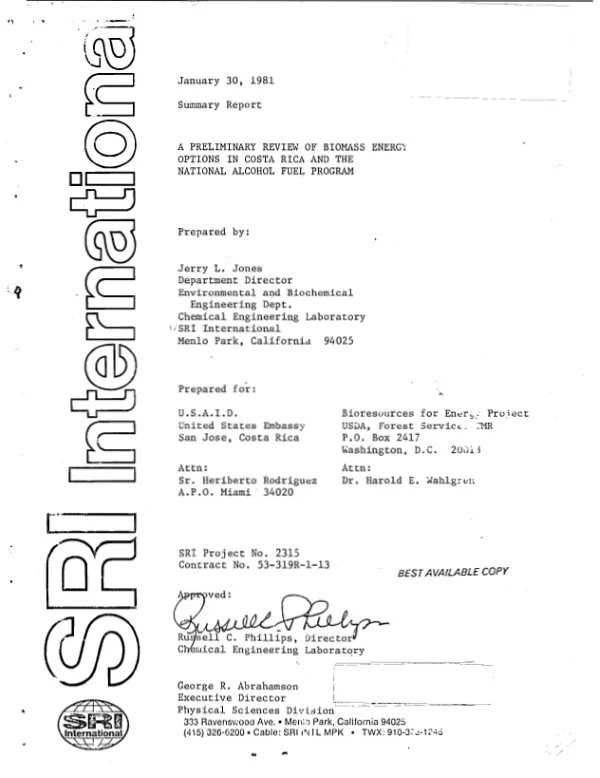
Preliminary review of biomass energy options in Costa Rica and the national alcohol fuel program
Sign inSTANFORD RESEARCH INSTITUTE
Preliminary review of biomass energy options in Costa Rica and the national alcohol fuel program
For an agricultural, oil importing country such as Costa Rica, the use of biomass as a source of transportation fuels is a topic of great interest.
Jones, Jerry L. · 1981
Sign in to readA free account is required to download.
Abstract
This analysis is intended to assist the Costa Rican government and USAID/CR to identify possible biomass energy projects. While emphasis is on technologies for converting biomass into liquid fuels, agronomic issues and alternative energy options are also explored. Costa Rica plans to build six facilities for converting biomass (primarily sugarcane, supplemented by molasses, cassava, and banana wastes) to hydrous ethanol. When all six are constructed, annual production will be 120 million liters or about 60% of the volume of gasoline currently used. Ethanol appears to be a reasonable choice. However, if Costa Rica could produce sufficient wood, other liquid fuels could become important in the future. The following issues relating to biomass conversion technologies are identified: use of hydroelectrically powered drives in sugarcane processing to allow use of bagasse as a fuel; possible sources and costs of energy for converting starch crops like cassava to ethanol; the optimal method for treating stillage; and the feasibility of using fermentation reactors. No definitive recommendation on the scale of ethanol production is made due to the lack of an environmental impact assessment. Complete substitution of gasoline and diesel fuel by ethanol would require an almost 50% increase in cultivated land. The current plan is to produce all the sugarcane for fuel in areas not currently producing sugarcane for sugar. However, several questions must be resolved regarding sugarcane and cassava characteristics, yields, and harvesting problems in high rainfall areas; the desirability and feasibility of producing a high fiber content sugarcane; and the suitability of other crops (e.g., sweet sorghum) as fuel sources. Finally, with regard to nonalcohol renewable energy, several ideas warrant consideration: electrically powered mass transit; electric cars; vehicle-mounted gasifiers operating on wood chips or pelletized fuels produced from excess bagasse; anaerobic digestion of animal manure and other agricultural wastes; and energy recovery from municipal solid wastes.