USAID DEC
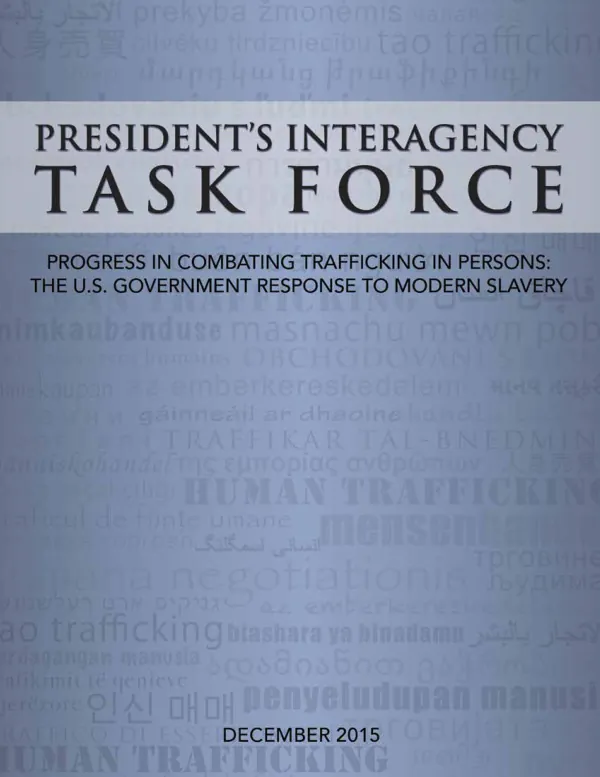
President's Interagency Task Force Progress in Combating Trafficking in Persons: The U.S. Government Response to Modern Slavery
Sign inUNITED STATES DEPARTMENT OF AGRICULTURE
President's Interagency Task Force Progress in Combating Trafficking in Persons: The U.S. Government Response to Modern Slavery
The United States continues to be a leader in the global movement to end modern-day slavery.
2015 · 32 pages
Sign in to readA free account is required to download.
Abstract
The country's efforts to combat human trafficking are guided by the principles of justice and fairness. The President's Interagency Task Force to Monitor and Combat Trafficking in Persons (PITF) brings together federal departments and agencies to ensure a whole-of-government approach to addressing human trafficking. Trafficking in persons, also known as human trafficking, includes both sex trafficking and the act of recruiting, enticing, harboring, transporting, providing, obtaining, or maintaining a person for compelled labor through the use of force, fraud, or coercion. The Trafficking Victims Protection Act of 2000 (TVPA) describes this compelled service using a number of different terms, including involuntary servitude, slavery, debt bondage, and forced labor. Human trafficking can include, but does not require, movement, and people may be considered trafficking victims regardless of whether they were transported to the exploitative situation, previously consented to work for a trafficker, or participated in a crime as a direct result of being trafficked. The PITF agencies have made significant progress in response to President Obama's call to strengthen federal anti-trafficking efforts. The agencies have brought together leaders from government, the private sector, law enforcement, academia, communities of faith, civil society, and courageous survivors to join forces in strengthening the nation's collective efforts to combat human trafficking. The PITF agencies have convened routinely to advance and coordinate both federal policies to combat trafficking in persons and implementation of the TVPA. Sex trafficking involves the recruitment, harboring, enticing, transporting, providing, obtaining, advertising, maintaining, patronizing, or soliciting a person for commercial sex acts, often through force, threats of force, fraud, coercion, or any combination of such means. Child sex trafficking is prohibited under U.S. law and by legislation in most countries around the world, and it involves the recruitment, enticement, harboring, transporting, providing, obtaining, advertising, maintaining, patronizing, or soliciting a minor to engage in commercial sex acts. Labor trafficking encompasses the range of activities involved when a person uses force or physical threats, psychological coercion, abuse of the legal process, deception, or other coercive means to compel someone to work. Labor trafficking includes bonded labor or debt bondage, debt bondage among migrant laborers, domestic servitude, forced child labor, and unlawful recruitment or use of child soldiers. The use of a bond or debt as a form of coercion is prohibited under U.S. law and is criminalized as a form of trafficking in persons.
Related documents