UNITED STATES DEPARTMENT OF STATE
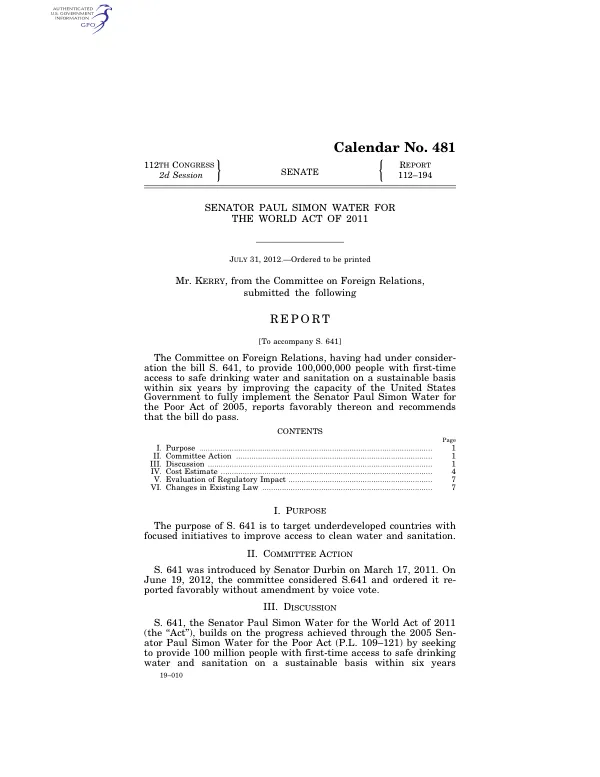
Senator Paul Simon Water for the World Act of 2011
The Senator Paul Simon Water for the World Act of 2011 aims to provide 100 million people with first-time access to safe drinking water and sanitation on a sustainable basis within six years.
2012 · 13 pages
Sign in to readA free account is required to download.
Abstract
This goal is built upon the progress achieved through the 2005 Senator Paul Simon Water for the Poor Act, which has already shown success in providing access to clean water and sanitation for millions of people worldwide. The Act seeks to strengthen the infrastructure at the United States Agency for International Development (USAID) and the State Department to ensure that water remains a development priority. It also fosters global cooperation on research and technology development, including regional partnerships among experts on clean water. Furthermore, the Act provides technical assistance and capacity-building to develop expertise within countries facing water and sanitation challenges. Since the enactment of the 2005 Water for the Poor Act, significant progress has been made in providing access to clean water and sanitation. In 2009, the U.S. provided nearly 2 million people with first-time access to an improved source of drinking water and more than 1.5 million people to improved sanitation. In FY 2010, USAID investments resulted in 2.8 million people gaining improved access to safe drinking water and 2.9 million gaining improved access to sanitation. However, despite this progress, water will continue to be one of the world's most pressing problems over the next century. Nearly one billion people continue to lack access to clean, safe water, and as many as three billion may face shortages by 2025 due in part to the effects of climate change. Inadequate water and sanitation contribute to nearly ten percent of the world's disease and more than two million deaths each year. The Act includes several important improvements, including the establishment of the "Senior Advisor for Water" at USAID and a "Special Coordinator for International Water" at the Department of State. These officials will be responsible for coordinating and conducting activities related to water and sanitation, including developing and overseeing implementation and coordination in high-priority countries of country-specific water strategies and expertise. The Act also requires the safe water and sanitation strategy to include an assessment of all U.S. government foreign assistance allocated to the drinking water and sanitation sector during the previous three fiscal years and across all U.S. government agencies and programs. This section includes recommendations on what the United States would need to do to support the goal of enabling first-time access to safe water and sanitation for 100 million people. In addition, the Act establishes a water and sanitation institutional capacity-building program in high-priority countries. This program will provide training in a comprehensive set of areas, including affordable, equitable, and sustainable access to safe drinking water and sanitation, education about the dangers of unsafe drinking water and sanitation, and the encouragement of behavioral changes to reduce individuals' risk of disease due to these conditions. The committee recognizes that the Water for the World Act can help strengthen global security by defusing tensions that are growing within and among nations as people react to the shortage of clean water and other emerging crises. The Act's goal of providing safe drinking water, sanitation, and hygiene is critical to achieving the broader development objectives of the United States.