USAID. MISSION TO BOTSWANA
Primary education improvement
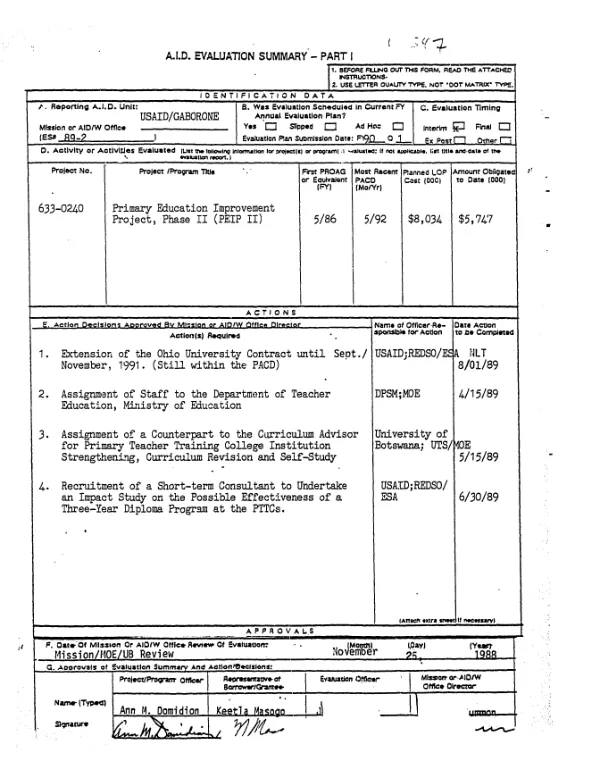
Evaluates project to help Botswana"s Ministry of Education (MOE) to upgrade the training of primary school teachers.
Sephuma, Peter; Otaala, Barnabas · 1985
Sign in to readA free account is required to download.
Abstract
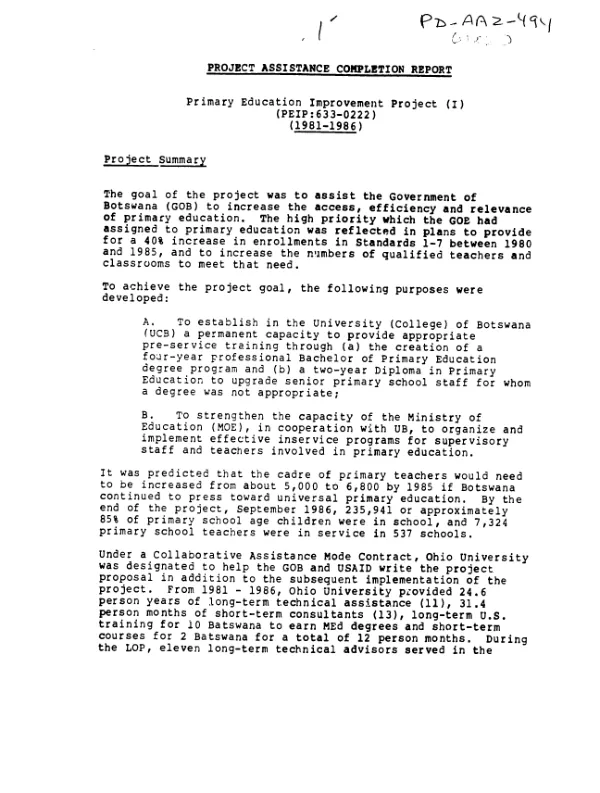
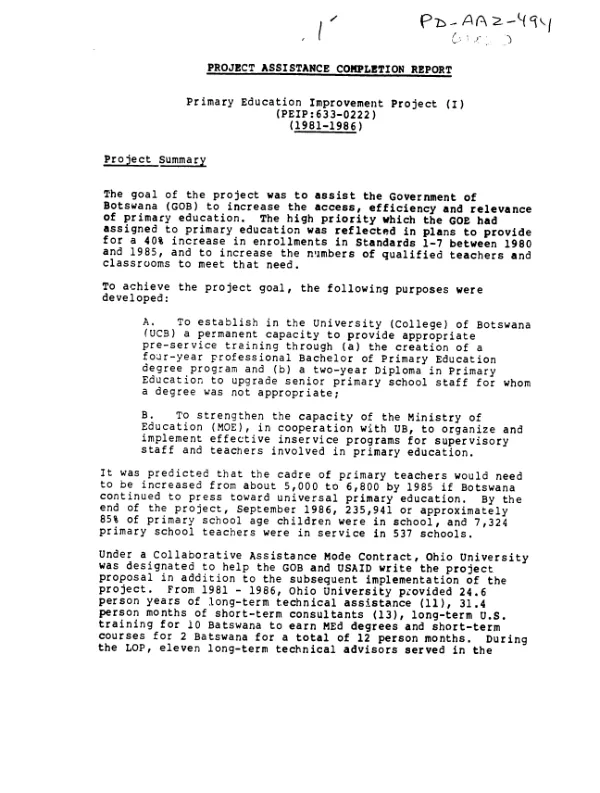
PES covers the period 5/84-6/85 and is based on document review, site visits, and interviews with MOE and TA personnel and returned participants. Achievements have exceeded targets. A 4-year B.Ed. and 2-year Diploma in Education program have been created at the University of Botswana (UB). The first 20 B.Ed. recipients have been assigned (15 as teacher trainers and 5 as Education Officers - EO"s), while diploma recipients (9-10 a year) have been taking positions as head and senior teachers or as EO"s. Inservice training has been very successful: 180 teachers and 32 EO"s, representing 60 schools, have been trained, vs. targets of 90, 27, and 30, respectively. Through spin-off benefits to some 150 other schools, about 2,000 teachers in all have been reached. There have been 63 teacher/EO workshops, 27 head teacher workshops (covering all 520 primary schools in Botswana), and 7 EO workshops, plus additional special workshops called by EO"s for head teachers. The content of the workshops has gradually changed from subject area emphasis to problemsolving and discussion of key educational issues. A practical handbook on teaching instruments has been distributed to all primary schools and to officials involved with primary and teacher education. Also, a change in the EO job description - from inspector to supervisor/guidance counselor - has increased enthusiasm among EO"s in general (many of whom are untrained) for educational improvement. In addition, six M.Ed. recipients have returned from U.S. training to positions at UB"s new Department of Primary Education, and have ably participated in inservice as well as pre-service teacher training. When the remaining fellow returns, localization of the UB department will be 88% complete. This successful project teaches the importance of: strong leadership, sustained direction, active problemsolving by key personnel, and cooperation among all parties; high-quality TA; the flexibility to change procedures, as well as goals, if necessary; and the importance of introducing only one or two innovations at a time, and matching them to the sociocultural context. Included are 21 recommendations with implications for Phase II.
Related documents