USAID DEC
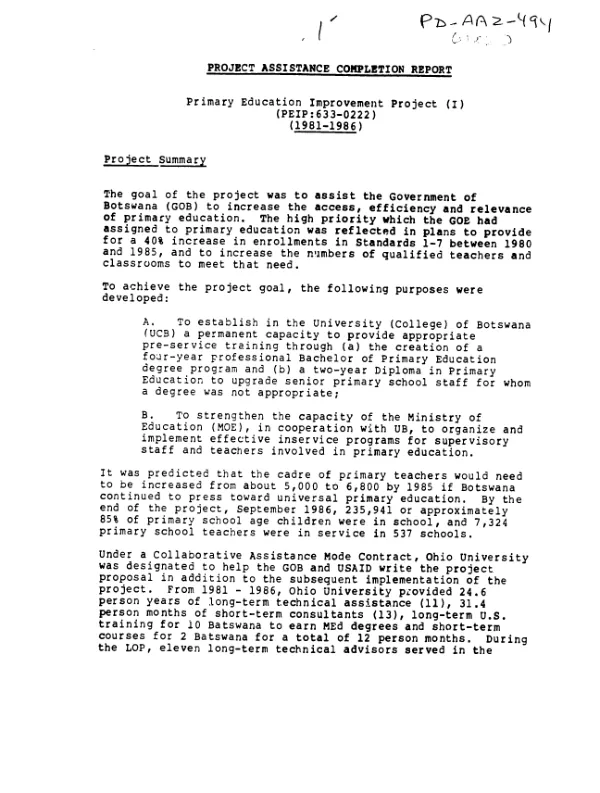
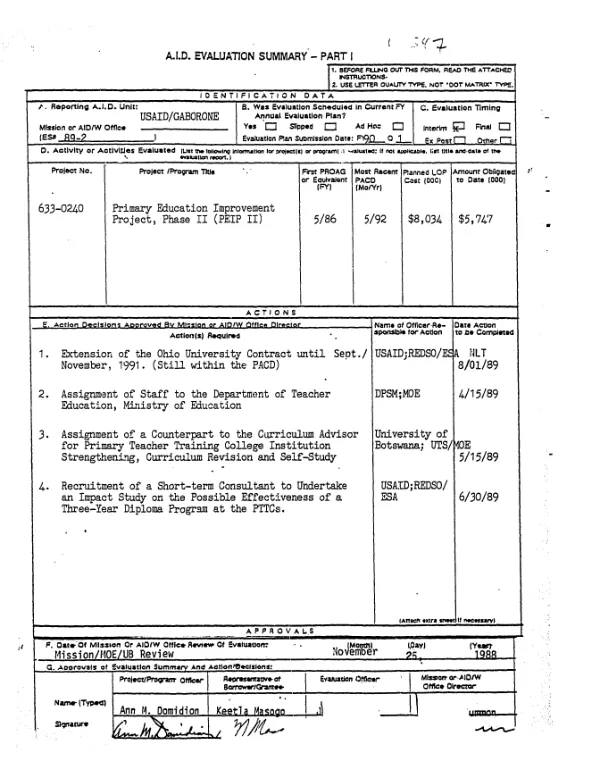
Project assistance completion report : primary education improvement project (I), (PEIP -- 633-0222) (1981-1986)
Sign inUSAID. MISSION TO BOTSWANA
Project assistance completion report : primary education improvement project (I), (PEIP -- 633-0222) (1981-1986)
PACR of a project (1981-1986) to upgrade primary education in Botswana by establishing pre-service training programs within the University of Botswana (UB) and in-service programs within the Ministry of Education (MOE).
1989
Sign in to readA free account is required to download.
Abstract
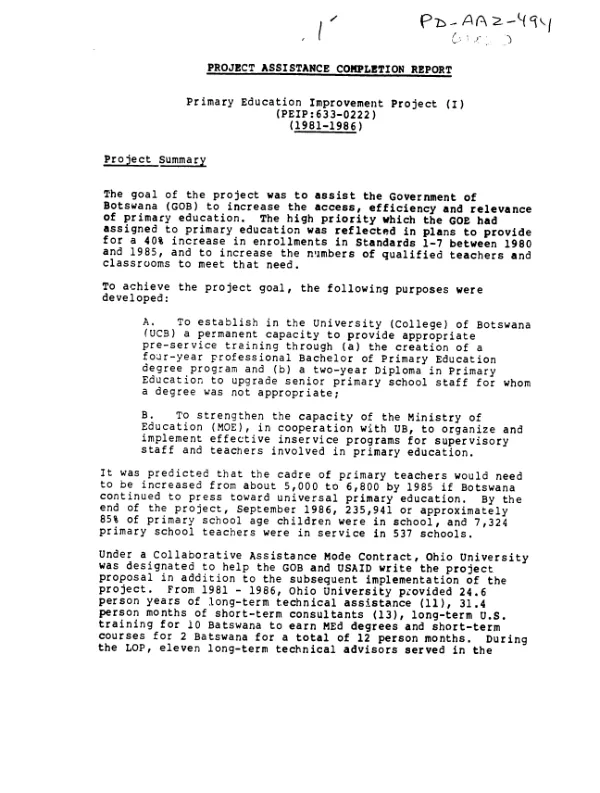
The project undoubtedly had a viable and sustainable impact on primary education in Botswana, primarily due to strong cooperation among the Mission, the MOE, the UB, and the Ohio University TA team. A Department of Primary Education was developed at the UB to provide diploma and bachelor's programs to older students (over 25) who had taught without having had the opportunity to study beyond high school. The successful U.S. participant training program was instrumental in this effort; all ten participants completed M.Ed. degrees on schedule and returned to teach at the UB, where in 1985 19 of 22 first semester courses were conducted by Batswana. Participants have also assumed additional professional responsibilities, including conducting teacher workshops, serving on curriculum panels, and teaching in other UB departments. To provide in-service teacher education, MOE advisors cooperated with UB staff to offer a network of workshops for about 120 teachers and education officers per year. These workshops - covering reading, math/science, and English as a second language - proved effective and worthwhile, especially because many participants conducted follow-on workshops in their districts. The project also succeeded in integrating Batswana staff into training teams, obtaining information concerning follow-on workshops, and improving selection criteria for workshop participants. The project was constrained by the lack of an operational MOE Department of Teacher Education, which would include primary, junior secondary, and senior secondary levels under one division. The responsibility for teacher education is still dispersed among different departments, straining scarce resources. Project design was flawed in that it did not directly address problem areas in primary school curriculum development or in Botswana's four primary teacher training centers. Several lessons were learned regarding the role of contractors. (1) The involvement of contract staff in selected non-contract activities related to project implementation can contribute effectively to the project's objectives. (2) Contractors occupying line positions in an institution or ministry can become both an asset and a detriment. In this project, the Chief of Party also served as the head of the Department of Primary Education. This situation simplified resource management, but placed the Chief in a difficult position in trying to meet both project targets and UB responsibilities. (3) A contractor under a collaborative assistance mode contract has a vested interest in ensuring that the design of the project proposal is implemented in the most efficient manner.
Related documents