USAID DEC
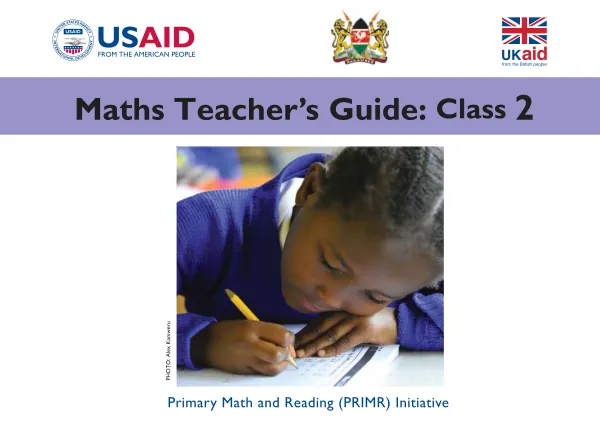
PRIMR MATHS Teacher’s Guide - Class 2
The MathemaƟ cs Programme is a comprehensive educational initiative designed to improve mathemaƟ cs understanding and scores among pupils.
194 pages
Sign in to readA free account is required to download.
Abstract
The programme is developed to help teach the criƟ cal mathemaƟ cs concepts introduced in the KICD MathemaƟ cs Syllabus. With the introducƟ on of a comprehensive mathemaƟ cs programme, mathemaƟ cs understanding and scores are expected to improve. The programme has two main components: the Teacher’s guide and the Pupil AcƟ vity Book. The Teacher’s guides are designed to provide teachers with a scaī old to support high quality mathemaƟ cs instrucƟ on. Teachers should use them as a guide and build on them as appropriate for their pupils. The guides use the following terms to help the teacher: Draw, Demonstrate, Guide, and AcƟ viƟ es. The programme is structured into 27 weeks, with the first three weeks having structured lesson guides for the teacher to refer to and understand the PRIMR methodology. The rest of the weeks from 4 to 27 are guides that help the teacher deliver the lessons successfully. Each week, the teacher is expected to conduct a lesson that includes an introduction, review, development, and activities. In Week 1, the teacher is expected to introduce the concept of counting by 1s from 51 to 70 and from 70 back to 51. The teacher is also expected to review writing and identifying numbers from 0 to 70. The development section includes teacher activities, such as demonstrating how to count by 1s from 51 to 70 and from 70 to 51. The activities section includes identifying numbers 51 to 70, rote counting by 1s from 51 to 70 and from 70 to 51, breaking numbers to subtract, and solving written addition problems. The programme also includes pupil activity books and exercise books, which are designed to support the teacher in delivering the lessons. The pupil activity book includes classwork pages that are designed to be completed by the pupils. The classwork pages include activities such as identifying numbers, counting by 1s, breaking numbers to subtract, and solving written addition problems. By the end of the lesson, pupils are expected to be able to identify numbers 51 to 70, count by 1s up to 70, break numbers to subtract with minuends up to 19, and solve written addition problems with sums up to 30. The programme is designed to be flexible and adaptable to the needs of the pupils, and the teacher is expected to use the guides as a guide and build on them as appropriate for their pupils.