USAID DEC
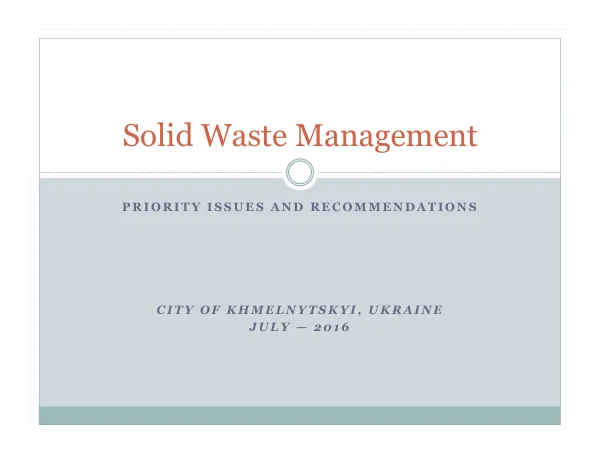
Priority Issues and Recommendations for Solid Waste Management in Khmelnytskyi, Ukraine
Sign inINTERNATIONAL FINANCE CORPORATION
Priority Issues and Recommendations for Solid Waste Management in Khmelnytskyi, Ukraine
The City of Khmelnytskyi, Ukraine, faces two fundamental issues in solid waste management.
2016 · 38 pages
Sign in to readA free account is required to download.
Abstract
A 60-year-old open landfill, which has exceeded its capacity, poses significant environmental concerns. Additionally, a changing regulatory environment presents challenges for the city's waste management practices. Four key tasks must be addressed: opening a new landfill, reducing waste sent to the landfill, meeting new standards for recycling and waste management, and closing and reclaiming the current landfill. The current landfill, operated by SpetKomunTrans, is nearly 9 hectares in size and has a height of 50 meters above ground. It receives 2,300 cubic meters of waste daily, amounting to approximately 100,000 tons annually. The landfill has been declared over its designed capacity by the State Environmental Inspection, violating design parameters and environmental safety requirements. The inspection report also highlights the site as a source of intense air pollution, necessitating urgent rehabilitation and reclamation. Ukraine's solid waste management sector faces significant challenges. According to a 2015 USAID Report and a 2014 study by the International Finance Corporation, the country produces 13 million tons of municipal solid waste annually, with only 3 to 8 percent being recycled. Most waste is sent to 6,700 landfills and dumps, many of which fail to meet minimal standards. The government of Ukraine aims to reform the solid waste management sector through private sector participation, seeking to reduce costs, increase recycling, and protect public health. The Clean City Project, a comprehensive nationwide program to build modern waste-processing facilities, included Khmelnytskyi in its scope. However, the project has been abandoned, leaving the city without a viable solution for its waste management issues. The city must now focus on addressing the current landfill's capacity issues and implementing new waste management practices to meet the changing regulatory environment and improve public health and environmental safety.