USAID. MISSION TO INDONESIA
Private sector development project -- investment promotion contracts
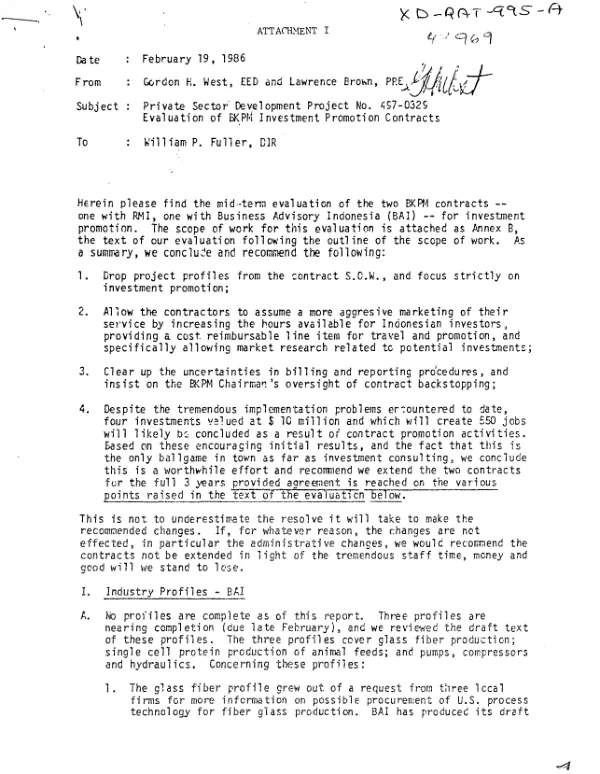
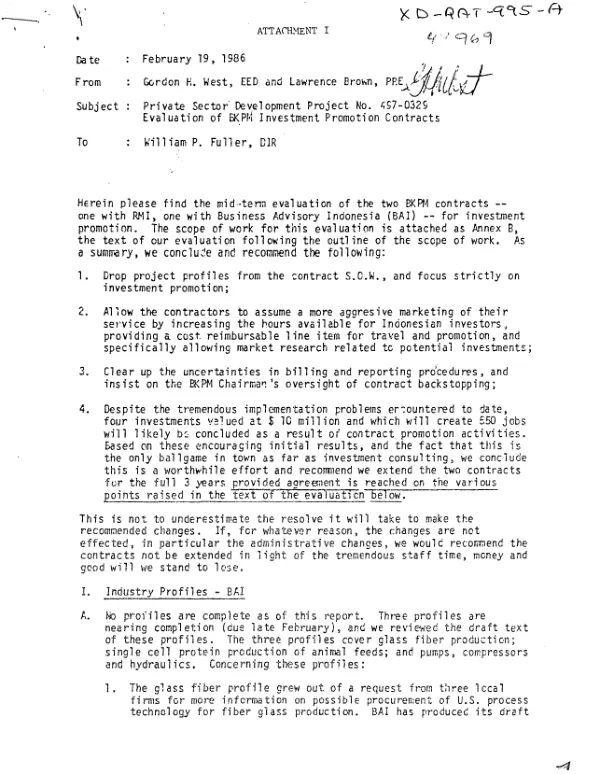
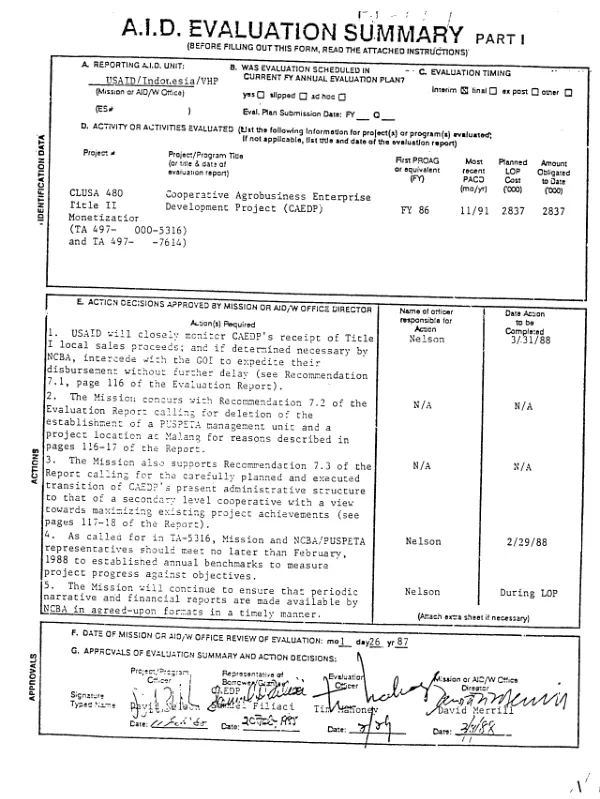
Summarizes attached mid-term evaluation (XD-AAT-995-A) of a project to test methods to strengthen the Indonesian private sector and to advise Indonesian decisionmakers on private sector development.
West, Gordon H.; Brown, Lawrence M. E. · 1986
Sign in to readA free account is required to download.
Abstract
The evaluation covered the period to 2/86; was based on document review, interviews, and frequent contact with concerned personnel; and focused on a project component in which the Indonesian Investment Coordinating Board (BKPM) retained two local contractors, P.T. Resources Jaya Teknik Management Indonesia (RMI) and Business Advisory Indonesia (BAI), to facilitate joint activities between Indonesian and U.S. entrepreneurs. To date, RMI and BAI have completed two industry profiles for investment projects, almost completed three others, and are anticipating two more. Several problems arose during preparation of the profiles, however. BKPM frequently rejected profile proposals, changed profile topics after partial completion, and refused to terminate infeasible profiles. Resulting profiles were reasonably thorough, yet none showed wide market potential. No investor interest has been reported thus far. Out of 250 inquiries regarding the consulting services offered by RMI and BAI under the project, 54 U.S. and Indonesian firms received consulting time. As a result of these consultations, six applications were made to BKPM, of which four - three from U.S. firms and one from an Indonesian firm - seem relatively certain. Together, these four firms represent a total potential investment of $l0 million and could create 550 new jobs. Compared to the contract investment of $240,000 for consulting services, this is a very good return by world investment promotion standards. On the negative side, BKPM, partly because of frequent staff changes, has performed poorly, issuing almost no written direction, incurring delays of 6 months and more, showing no real interest in the project"s substance, and acting arbitrarily in reviewing investment profiles. Administration by the contractors, whose work seems to be good, was also poor. Quarterly reports and billings were irregular and poorly documented. USAID/I should have acted earlier in demanding better service from the contractors. Key recommendations are to: (1) eliminate profiles from the contract scope of work and focus efforts on investment promotion and consulting; (2) permit contractors to market their services more aggressively; (3) resolve uncertainties in billing and reporting procedures; and (4) based on the encouraging initial results, and because no other efforts are now being made in investment consulting in Indonesia, extend the two contracts to the full 3 years - if agreement is reached on the various points discussed in this evaluation.