USAID. MISSION TO INDONESIA
Cooperative agrobusiness enterprise development project (CAEDP)
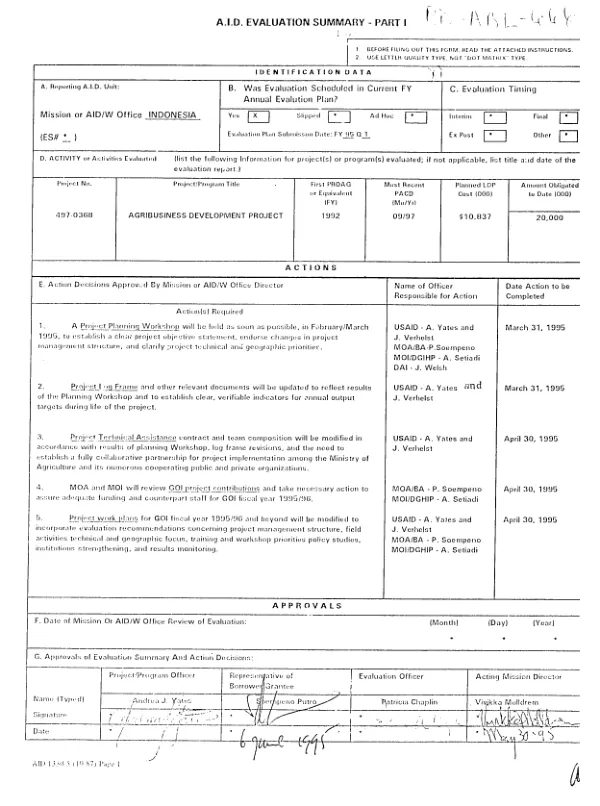
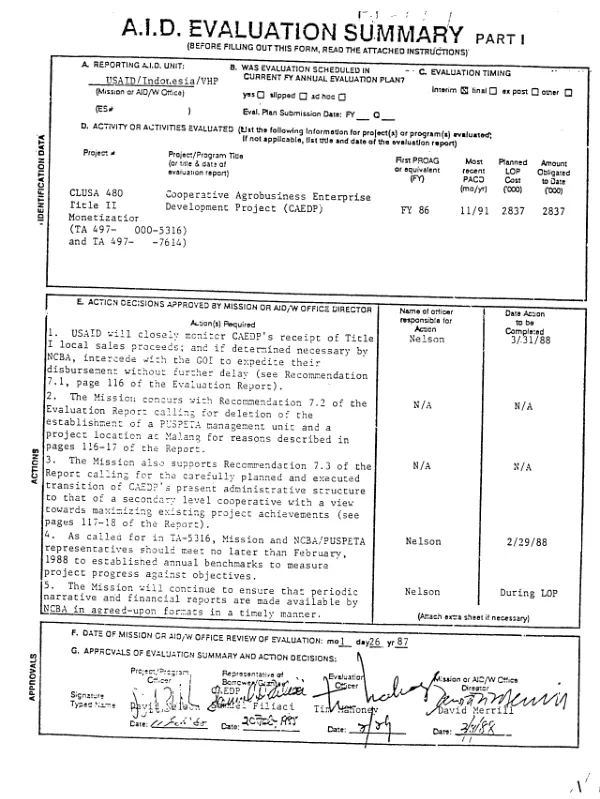
Summarizes mid-term special evaluation (PD-AAW-983) of the Cooperative Agrobusiness Enterprise Project, funded with P.L.
1988
Sign in to readA free account is required to download.
Abstract
480 local currency, to improve the capacity of Indonesia"s cooperative system to provide production and marketing services through their village co-ops (KUD"s). Evaluation covered the period 11/85-10/87. Overall, the team found that the project is well managed and making good progress toward meeting its objectives. However, programmed funds for local currency funding for infrastructure and operating capital have not been released from proceeds from P.L. 480 Title I sales. This necessitated a reduction in the project"s scope and the consolidation of activities at two sites into a single organization. In addition, because of declining government revenues, the GOI encouraged the project to become involved in export oriented/employment intensive ventures which have been effective and profitable. Some of these ventures have been far beyond those originally envisioned for the project. Some of these activities have also pioneered mutually beneficial joint ventures with the private sector. Sales at the Klaten location have increased at an average rate of 29% per annum for the past 3 years, and are forecast to increase 65% between 1986 and 1987. In 1987, Klaten showed a net profit of over Rp. 100 million after net losses in 1985 and 1986. The Luwu location has only been in operation for 15 months and its capital is more restricted than Klaten"s. Although income from new activities in Luwu began to be realized only in the last quarter of 1987, it has increased sales steadily. Both locations are expected to achieve the revenue levels and corresponding margins detailed in their 15-year financial projections. The evaluation team cited three main recommendations: (1) Title I funds should be disbursed immediately; (2) establishment of the Malang project site should be eliminated from the project"s scope; (3) the transition from the current project management structure to secondary cooperative status should be undertaken carefully and gradually to ensure that existing achievements are maintained. The principal lessons learned are: (1) joint private sector/cooperative working relationships can be mutually beneficial; (2) diversification from government-sponsored activities is necessary for the project"s long-term viability; (3) substantial research is essential before large-scale implementation of new economic activities at the farmer level; (4) strict control over granting credit to both KUD"s and non-KUD"s is essential to long-term solvency; and (5) replication of the project model to other areas on a uniform basis will fail. See also abstract of PD-AAW-983. (Author abstract, modified)
Related documents