USAID DEC
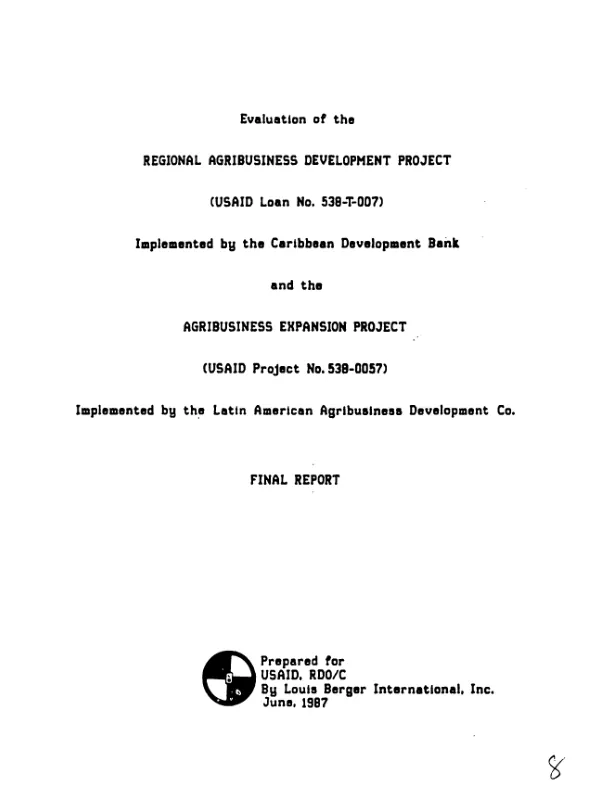
Private sector program - agribusiness cluster, regional agribusiness development (RAD), agribusiness expansion project (AEP)
Sign inUSAID. BUR. FOR LATIN AMERICA AND THE CARIBBEAN. REGIONAL DEVELOPMENT OFC.
Private sector program - agribusiness cluster, regional agribusiness development (RAD), agribusiness expansion project (AEP)
Summarizes attached impact evaluation of the Regional Agribusiness Development (RAD) and Agribusiness Expansion (AEP) projects to provide credit to, respectively, small farmers and medium to large agricultural producers to promote agribusiness formation in member nations of the Organisation of Eastern Caribbean States (OECS).
1987
Sign in to readA free account is required to download.

Abstract
Evaluation covered the period 1978-6/86 and was based on interviews with project personnel and loan recipients and document review. Both projects were dismal failures. This was largely because both RAD and AEP had trouble finding suitable agribusiness enterprises to participate in subprojects (SP"s), since it was falsely assumed that the offer of credit alone would cause entrepreneurs to emerge. RAD subprojects financed directly by the Caribbean Development Bank (CDB) experienced serious financial problems, while RAD loans to small farmers through the National Development Finance Corporations (DFC"s) tended to be used for farm improvement rather than the agro-processing ventures envisaged in the project paper. AEP did have some limited success in aiding enterprises that exported nontraditional crops to specialized markets, but both projects were hampered by multiple restrictions on lending (placed by A.I.D., the DFC"s, and CDB); these restrictions limited the number of agribusinesses that qualified for support and severely hampered the ability of the lending institutions to disburse the funds for their originally intended use. As a result, the projects had very little impact on the agriculture sector. The projects teach that credit is not the major constraint on agribusiness in the Eastern Caribbean. Due to weather, water, and soil problems, there is a dearth of fundable SP"s in the region. If lending criteria in credit projects preclude commitments to risky ventures, such projects are unlikely to have significant impact. Other lessons are: (1) project officers and loan approval committees should work closely together to set realistic targets for SP performance; (2) the most successful SP"s export products to market niches in industrialized countries; and (3) privately owned agribusiness SP"s have been significantly more successful than government-owned entities. Recommendations are for A.I.D."s Regional Development Office/Caribbean (RDO/C) to reconcile its agribusiness financing objectives with its institutional attitudes towards risk. RDO/C"s new agribusiness financing project, the High Impact Agricultural Marketing Project (HIAMP), should be carefully monitored and given full support during the early stages of implementation. At the same time, contingency plans should be developed to protect the Mission"s investment should participating enterprises perform below expectations. AEP"s few success stories should be publicized.
Related documents