USAID. BUR. FOR LATIN AMERICA AND THE CARIBBEAN. REGIONAL DEVELOPMENT OFC.
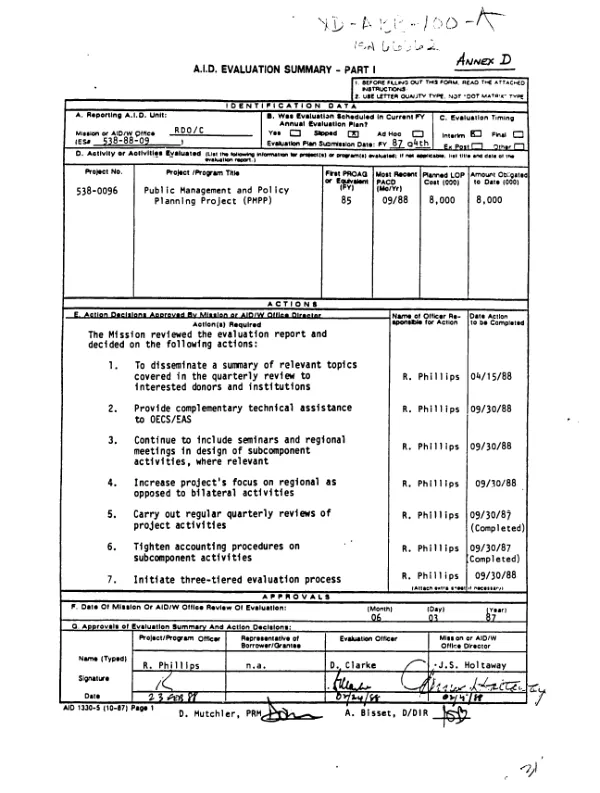
Public management and policy planning project (PMPP)
Summarizes interim evaluation (unattached) of a project to help member countries of the Organization of Eastern Caribbean States upgrade their economic policies and enhance their capabilities in policy analysis and implementation.
1988
Sign in to readA free account is required to download.
Abstract
External evaluation covered the period 1986-5/87. The project holds an important place in the Mission"s development strategy and has addressed key areas essential to improved fiscal policy, such as tax reform, budgeting systems, public sector investment, tax administration, and information for decisionmaking. The project has responded very quickly to host country requests and has been managed in a manner sensitive to countries" perceived needs. As the project has been generally well received, it has successfully promoted the implementation of new systems. Problem areas have concerned the degree of commitment by host countries and an absence of local counterparts for consultants. The project should coordinate with other donors and institutions to develop indigenous capabilities, particularly at the senior decisionmaking level. A.I.D. should consider providing complementary TA to other regional institutions to develop enhanced capacity for policy research. The project should emphasize seminars, regional meetings, etc. to disseminate and discuss ideas and proposals developed under the project. Four major lessons were learned. (1) In many respects, public management (e.g., tax administration) is as important as policy planning (e.g., tax system reform) in determining the success of a policy. (2) A.I.D. should use caution when providing fiscal reform assistance in a country which does not permit sufficient discussion of policy options prior to decisionmaking. Adverse public reaction after the decisionmaking process can force a government to modify an efficient proposal to such a degree that it becomes ineffective. (3) When providing TA (particularly long-term), A.I.D. must ensure that adequate counterpart resources are available to make productive use of this assistance. (4) While objectively verifiable indicators for subcomponents of projects such as the present one are often easy to devise, benchmarks for the project as a whole are much harder to develop. An important element of an interim evaluation should therefore be to establish such indicators.