USAID DEC
Professional Skills Development Course for Women in the Energy Sector
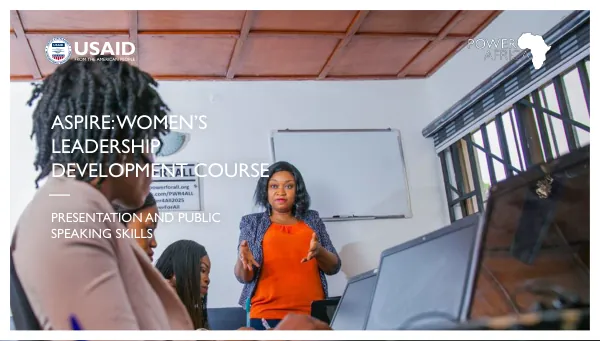
The Aspire: Women's Leadership Development Course focuses on enhancing presentation and public speaking skills.
2022 · 30 pages
Sign in to readA free account is required to download.
Abstract
The course aims to equip participants with the knowledge and skills necessary to deliver effective presentations and engage in confident public speaking. Key objectives include developing the ability to articulate a message, practice strategies for becoming a better public speaker, and gain practical skills to manage fear during presentations. The course covers essential components of effective presentations, including preparation, presentation, and reinforcement. Preparation involves understanding the audience, organizing content, and rehearsing the presentation. Presentation entails articulating the message, using visual aids, and engaging the audience. Reinforcement involves handling questions and feedback, and evaluating the presentation's effectiveness. Public speaking is a critical aspect of the course, with a focus on the golden rules of public speaking. These rules emphasize the importance of knowing the audience, organizing content, making eye contact, varying tone and pitch, and using body language effectively. The course also addresses the fear of speaking, providing strategies for managing anxiety and building confidence. The course utilizes interactive activities and exercises to facilitate learning. Participants engage in silent interviews, where they introduce themselves to a partner without speaking, and then share what they have learned about each other in the chat. This activity promotes nonverbal communication and encourages participants to think creatively about how to convey information without speaking. The course also covers the concept of presentation and public speaking, highlighting the differences between formal and informal presentations. Formal presentations involve speaking to a large group of people, often from a lectern, and aim to persuade, inform, or entertain the audience. Informal presentations, on the other hand, involve intimate communication with a small audience, often using a two-way conversation method. Throughout the course, participants are encouraged to practice their presentation and public speaking skills through various activities and exercises. These include developing an elevator pitch, practicing strategies for becoming a better public speaker, and engaging in presentations to management. The course also provides resources and handouts, such as an elevator pitch activity, components of effective presentations, and the golden rules of public speaking, to support participants in their learning journey.